Cvent vs Eventbrite: the short answer
Cvent vs Eventbrite is not a like-for-like comparison, because one is built for corporate programmes and the other for selling tickets.
Eventbrite is a ticketing and discovery tool for public events. Cvent is a management platform for corporate and association event programmes. They overlap on registration, but they are built for different buyers.
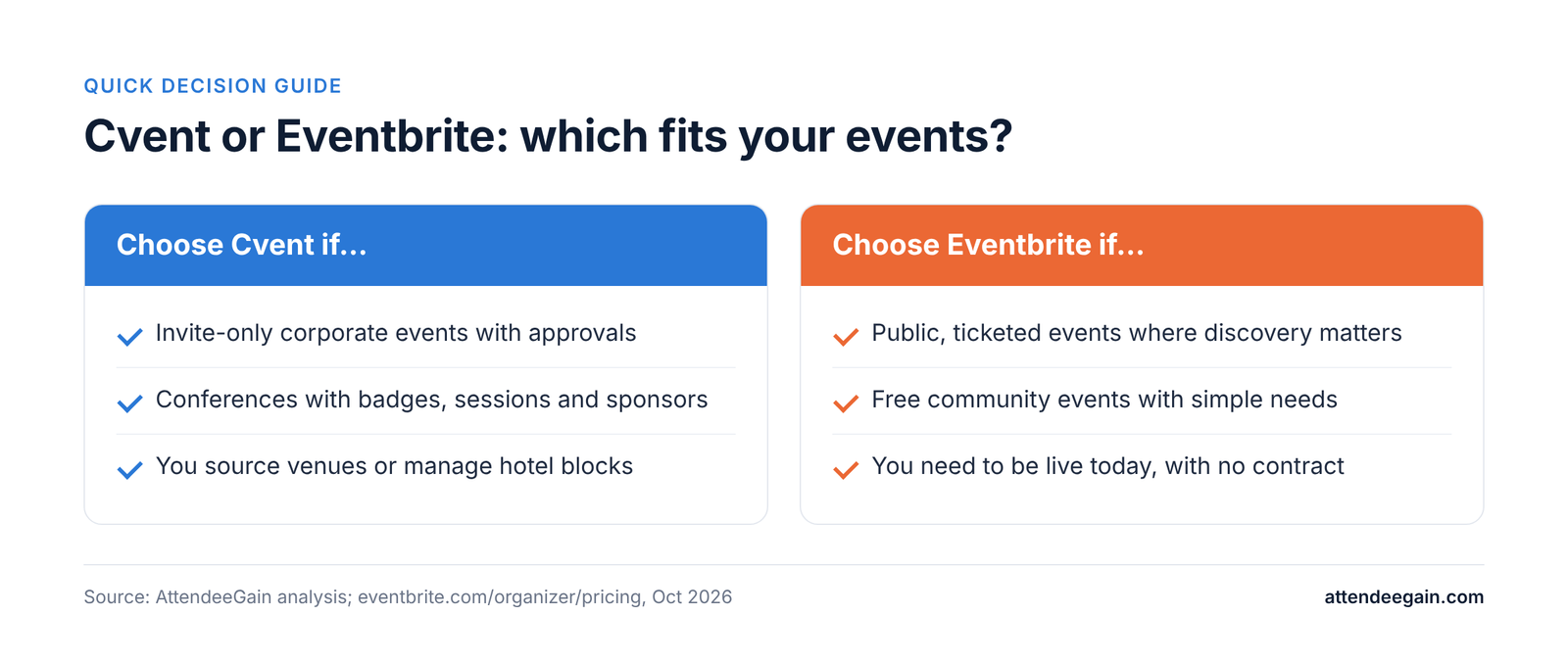
Choose Eventbrite if you sell tickets to the public, want people to find your event on its marketplace, and need to be live today with no contract. Choose Cvent if you run invite-only or corporate events with approvals, multiple attendee types, hotel blocks, onsite badging and CRM reporting.
Most organisations that ask this question are growing out of Eventbrite. The signs: events have become private rather than public, registration needs logic Eventbrite cannot handle, finance wants budget tracking, or the per-ticket fees on paid events have grown into real money.
Cvent vs Eventbrite at a glance
| Cvent | Eventbrite | |
|---|---|---|
| Built for | Corporate, association and enterprise event programmes | Public, ticketed events of any size |
| Pricing model | Annual licence, quote only | Free for free events; per-ticket fees on paid tickets |
| Paid ticket fees | Set by your contract and payment setup | 3.7% + $1.79 service fee per ticket, plus 2.9% processing per order |
| Contract | Annual, often multi-year | None for self-serve |
| Public discovery | No marketplace | Marketplace Eventbrite says reaches about 89 million monthly users |
| Registration logic | Multiple attendee types, approvals, housing and travel | Ticket types, add-ons, custom questions |
| Venue sourcing and room blocks | Yes | No |
| Onsite | OnArrival kiosks, on-demand badges, session check-in | Organizer app with ticket scanning |
| Event app | Attendee Hub | No dedicated attendee event app |
| CRM depth | Deep Salesforce and other connectors | Integrations through its app marketplace |
| Setup time | Weeks for a first event | Minutes to hours |
Cvent vs Eventbrite feature-by-feature
Registration
Eventbrite handles ticket types, early-bird and VIP tiers, promo codes, add-ons and custom questions well, and attendees can check out in under a minute. It stops short of corporate needs such as manager approvals, different registration paths per attendee type, and capturing hotel and travel in the same form. Cvent does all of those, at the cost of a longer build.
Event pages and branding
Eventbrite pages are quick to publish but follow Eventbrite’s layout, and reviewers on SelectHub point to limited customisation for a heavily branded look. Cvent’s Site Designer supports full branding and custom code, with more time needed to get it right.
Marketing and discovery
This is Eventbrite’s real advantage. Its marketplace puts public events in front of people already looking for something to attend, and it adds email campaigns, Eventbrite Ads and social ad tools. Cvent has no public marketplace; its marketing tools are built for known invite lists.
Onsite
Eventbrite’s organizer app scans tickets and supports contactless payment at the door. Cvent’s OnArrival adds self-service kiosks, on-demand badge printing, session check-in with capacity control, and staffed onsite support. For a 3,000-person conference with badges, Cvent is the safer choice.
Data and reporting
Eventbrite reports on ticket sales and audience demographics. Cvent adds configurable reporting across many events, budgets and deep CRM sync, which is why reviewers single out its Salesforce integration.
Support
Eventbrite offers email support and 24/7 chat for paid events, with priority phone support for large organisers through its sales team. SelectHub notes frequent reviewer complaints about support quality. Cvent offers 24/7 support from a 1,800-person client services team.
Cvent vs Eventbrite pricing: Eventbrite’s fees worked out
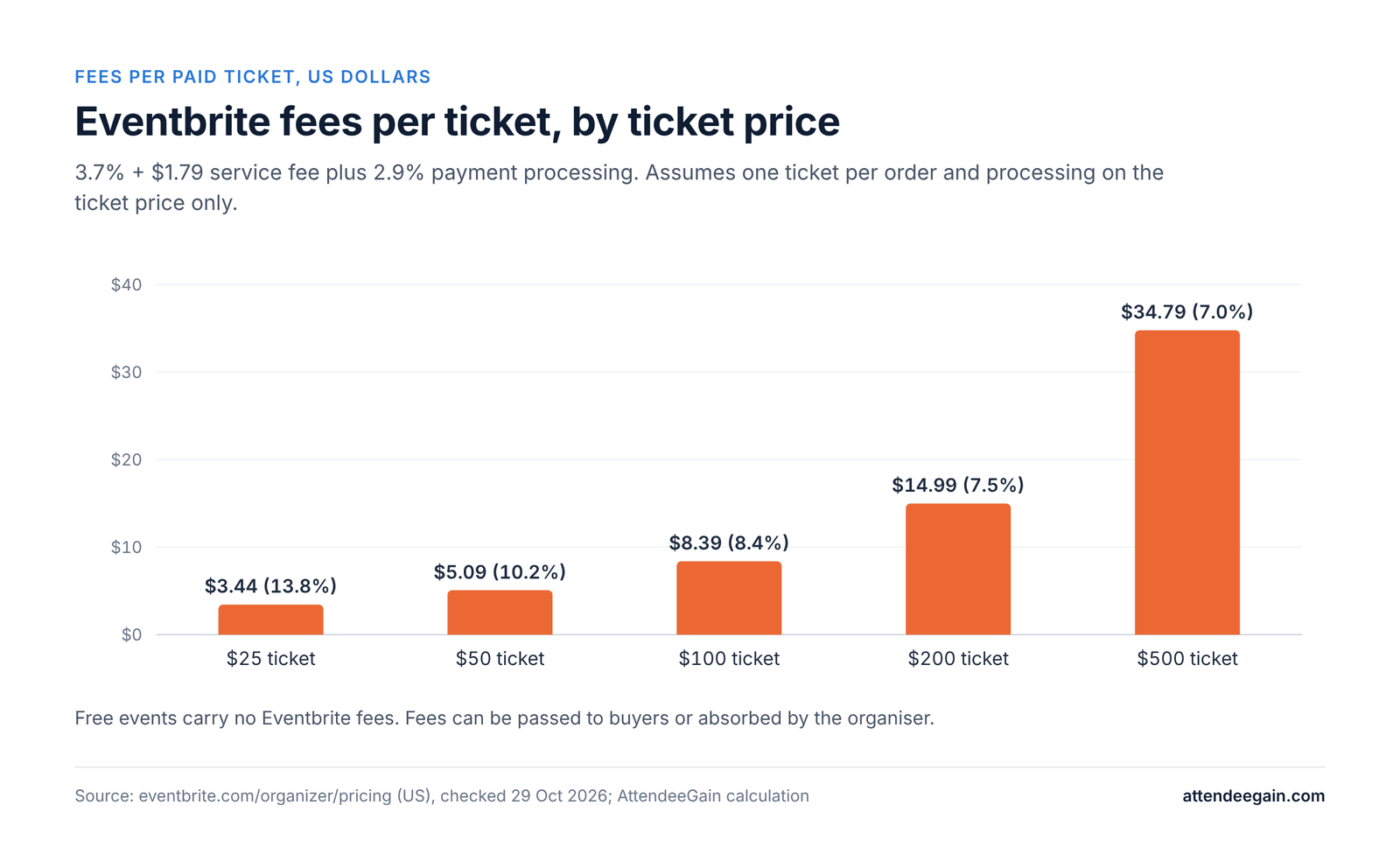
Eventbrite is free for free events. For paid events, it charges a 3.7% + $1.79 service fee per ticket and a 2.9% payment processing fee per order. By default the buyer pays the fees, but you can choose to absorb them. Eventbrite Pro, which adds higher email volumes, starts at $15 a month.
Here is roughly what those fees add up to. Figures assume one ticket per order and the processing fee on the ticket price only, so treat them as estimates.
| Event | Ticket price | Fees per ticket (approx.) | Total fees (approx.) |
|---|---|---|---|
| Free internal summit, 500 people | $0 | $0 | $0 |
| Paid workshop, 300 people | $200 | $14.99 | about $4,500 |
| Paid conference, 300 people | $500 | $34.79 | about $10,400 |
| Paid conference, 1,000 people | $500 | $34.79 | about $34,800 |
Whether those fees come out of your budget or your attendees’ pockets is a choice, but someone pays them.
Cvent publishes no prices. It sells annual Professional and Enterprise editions, with venue sourcing, Passkey, lead capture and other modules as extras. Docket’s research estimates typical annual licences at about $19,550 to $79,000 or more; that is a third-party figure, not Cvent’s.
The crossover point. For free events, Eventbrite costs nothing and Cvent will rarely make financial sense on price alone. For a programme of paid events, Eventbrite’s fees can reach the same range as a Cvent licence. At that point the decision should turn on features, not fees.
Cvent vs Eventbrite security and compliance
Both handle payments securely and serve large organisations. Cvent holds SOC 2 Type II, ISO 27001 and PCI DSS certifications and offers SSO and multi-factor authentication in its Enterprise edition, which is what corporate IT and procurement typically require for internal events. If your security team needs a vendor questionnaire answered, ask Eventbrite’s sales team for its current compliance documentation before committing a corporate programme to it.
Reliability
Both run very large volumes of events. Eventbrite publishes a public status page; so does Cvent. For a flagship event, check each status history for outages in the months you run events, and ask about live-event support.
Switching from Eventbrite to Cvent
This is the common direction. Export past attendee lists and order history from Eventbrite before you leave; Cvent can import contacts. Expect to rebuild event pages, registration paths and emails, and to train at least one person properly on Cvent. Plan the first Cvent event as a smaller one, not your flagship, and keep Eventbrite for public-facing events if discovery still matters to you. Some organisations run both.
Cvent vs Eventbrite: which should you choose?
| Your situation | Better fit | Why |
|---|---|---|
| Public, ticketed events where discovery matters | Eventbrite | Marketplace reach and fast setup |
| Free community or internal events, no complex needs | Eventbrite | No cost for free events |
| Invite-only corporate events with approvals | Cvent | Registration logic and governance |
| Conferences with badges, sessions and sponsors | Cvent | OnArrival, Attendee Hub, exhibitor tools |
| You source venues or manage hotel blocks | Cvent | Supplier network and Passkey |
| High-volume paid events where fees are piling up | Compare both | Fees may now rival a licence |
Cvent vs Eventbrite FAQs
Is Eventbrite free? Yes for free events. Paid tickets carry a 3.7% + $1.79 service fee and 2.9% processing per order.
Is Cvent better than Eventbrite? For corporate and association programmes, yes. For public ticketed events where discovery matters, Eventbrite is usually the better fit.
Can Eventbrite handle a corporate conference? It can sell the tickets. It lacks approvals, complex registration paths, venue sourcing and Cvent-level onsite badging.
Does Cvent have a public marketplace like Eventbrite? No. Cvent is built for known audiences and invite lists.
Can we use both? Yes. Some organisations keep Eventbrite for public events and use Cvent for corporate programmes.
Sources: Eventbrite pricing, Cvent pricing.
Outgrowing Eventbrite?
We set up Cvent for teams moving from simpler ticketing tools, including registration builds and onsite check-in. Talk to our team. See our Cvent expertise and event registration services, or contact us.