Best event management software: the short answer
The best event management software depends on your event type and volume. Here are ten platforms compared by what they do well, what they cost and where they run out of capability.
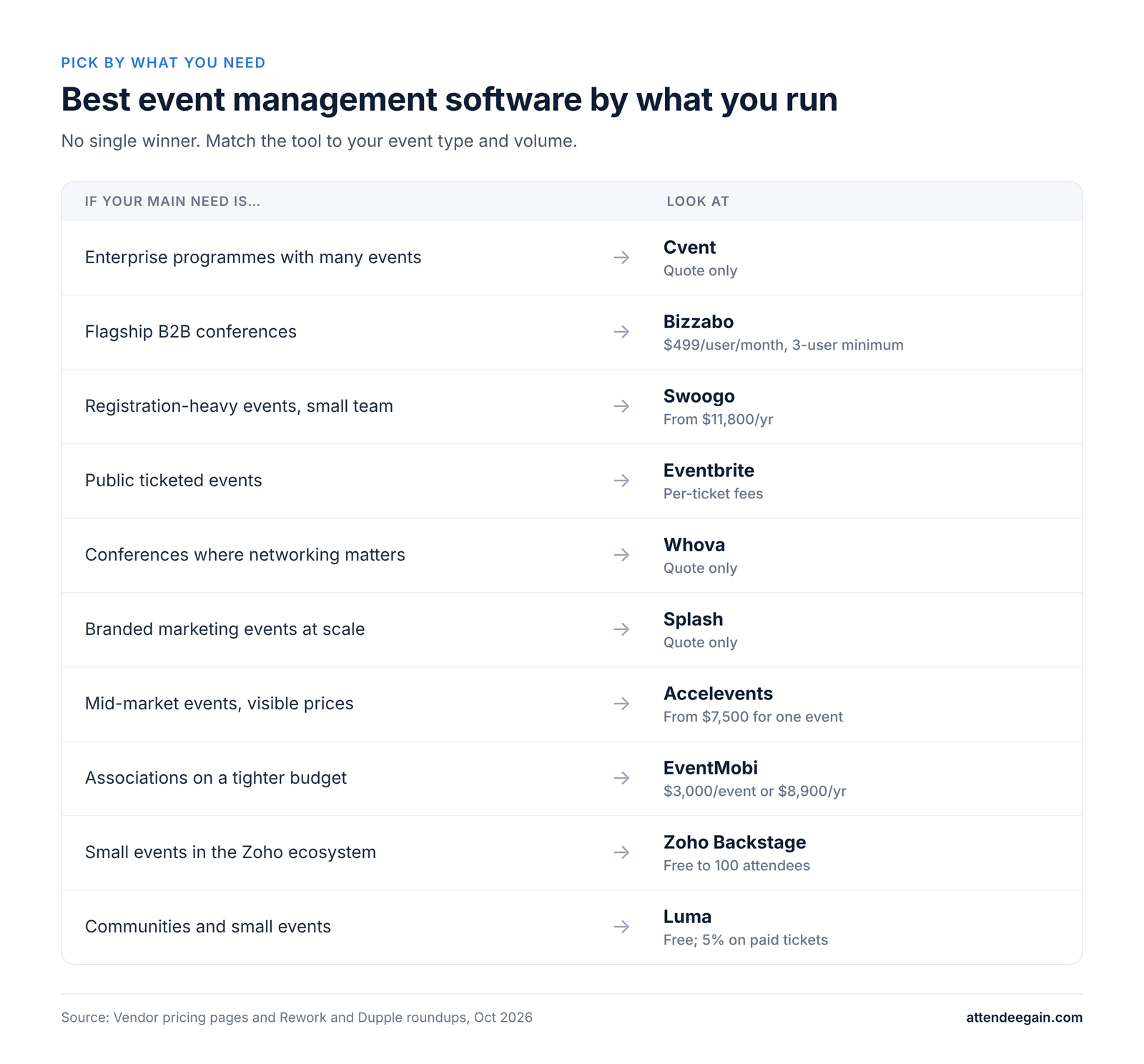
There is no single best platform. The right one depends on your event type, how many events you run, and what you can spend at that volume.
| If you run… | Look at |
|---|---|
| Enterprise programs with many events | Cvent |
| Flagship B2B conferences with a polished app | Bizzabo |
| Registration-heavy events with a small team | Swoogo |
| Public ticketed events | Eventbrite |
| Conferences and associations where networking matters | Whova |
| Branded marketing events at scale | Splash |
| Mid-market events and you want visible prices | Accelevents |
| Association or nonprofit events on a tighter budget | EventMobi |
| Small events inside the Zoho ecosystem | Zoho Backstage |
| Communities and small events | Luma |
How we picked
We grouped tools by the job they do, not by a score. For each we checked what the vendor publishes about pricing, what third-party roundups report, and where the product runs out of capability. Prices are the latest we could find and change often; where a figure is an estimate, we say so. We have not run every platform ourselves. AttendeeGain implements several of them (Cvent, Bizzabo, Swoogo, Splash and Whova), so we flag that on those entries. Many roundups in this space rank the author’s own product or carry affiliate links; this one does neither.
The 10 best event management platforms
1. Cvent: best for enterprise event programs
Cvent covers registration, venue sourcing, an attendee app, onsite check-in and cross-event reporting, licensed as separate solutions. It is the broadest platform here and the heaviest to run. Pricing is quote-only. It can be overkill if you run fewer than ten events a year. We implement it: see Cvent expertise.
2. Bizzabo: best for flagship B2B conferences
Bizzabo is known for a polished attendee app, CRM integration and its own onsite hardware. The price floor is $499 per user per month with a three-user minimum, about $18,000 a year, so it punishes small teams. See Bizzabo expertise.
3. Swoogo: best for registration-heavy events
Swoogo is known for flexible registration logic and unlimited registrations, licensed per user. Plans start around $11,800 a year (Professional, two seats). Its virtual features are thinner. See Swoogo expertise.
4. Eventbrite: best for public ticketed events
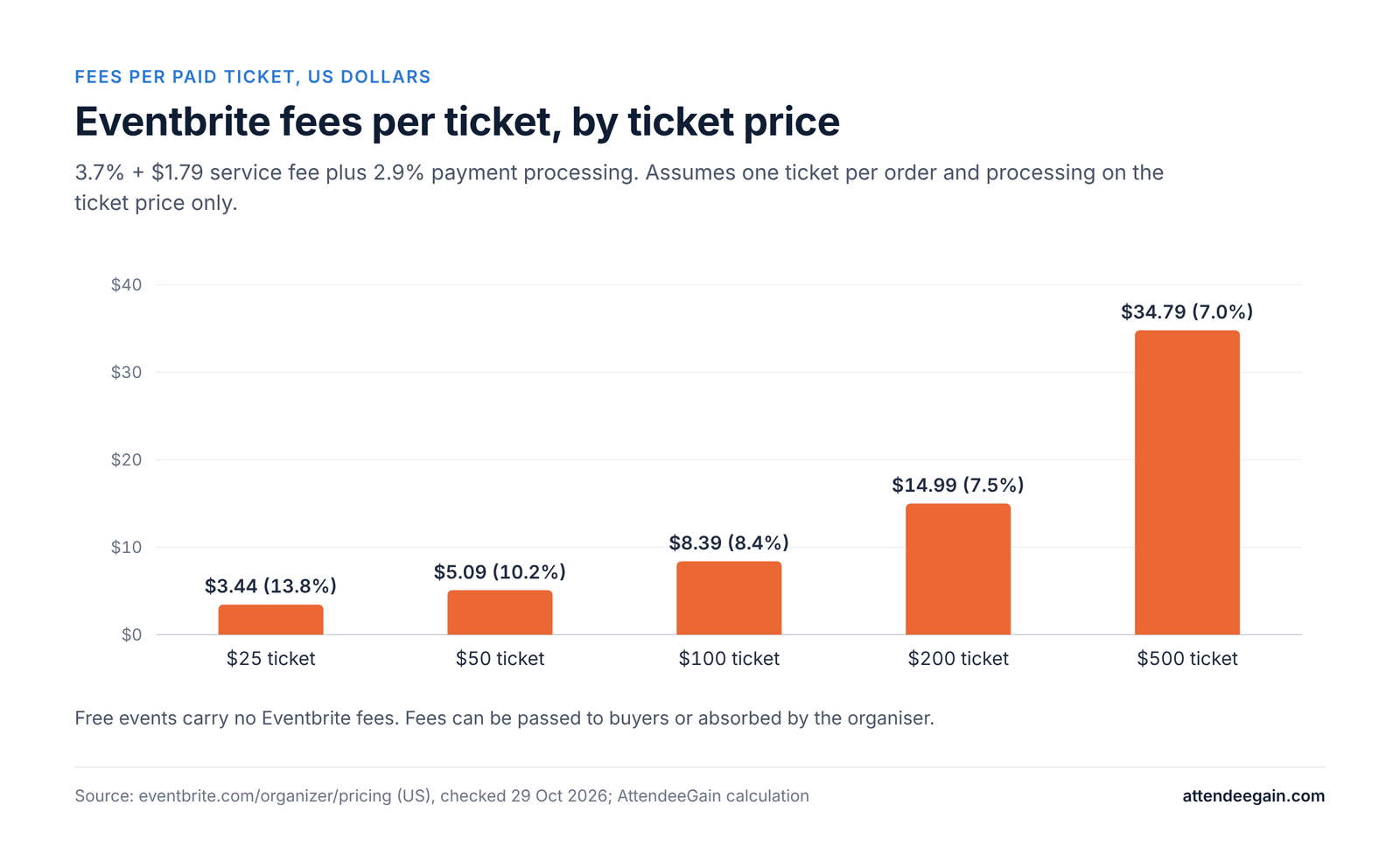
Eventbrite is free to publish for free events and charges fees on paid tickets, with a built-in discovery audience. On low-priced tickets the fees add up. Branding on checkout is limited.
5. Whova: best for attendee networking
Whova’s app and networking are the draw, and independent roundups rate it highly. Pricing is quote-only, with add-ons for registration and badging. See Whova expertise.
6. Splash: best for branded marketing events
Splash offers on-brand pages, email promotion and guest management with unlimited events and registrations on its Pro and Enterprise plans, priced by quote and by user license. It is lighter on complex logistics. See Splash expertise.
7. Accelevents: best for visible pricing
Professional starts at $7,500 for one event and Business at $13,500 for unlimited events, with unlimited admin seats and 24/7 support. Billing period and add-on prices are not stated on the page.
8. EventMobi: best for associations and nonprofits on a budget
EventMobi lists $3,000 per event or $8,900 a year with no registration fees. Hardware and badges cost extra.
9. Zoho Backstage: best for small events in the Zoho ecosystem
A free tier covers up to 100 attendees, with Essentials at $99 a month or $299 per event. Per-event licenses add up if you run many events.
10. Luma: best for communities and small events
Luma is free with a 5% fee on paid tickets, and Plus is $59 a month billed yearly. It is fast and attractive but lacks badges, exhibitors and deep CRM sync, so it is too light for large events.
Also worth a look: Stova (a combined enterprise suite, quote-only), EventsAir for complex conferences, and Brella for networking-first events.
Event management software pricing compared
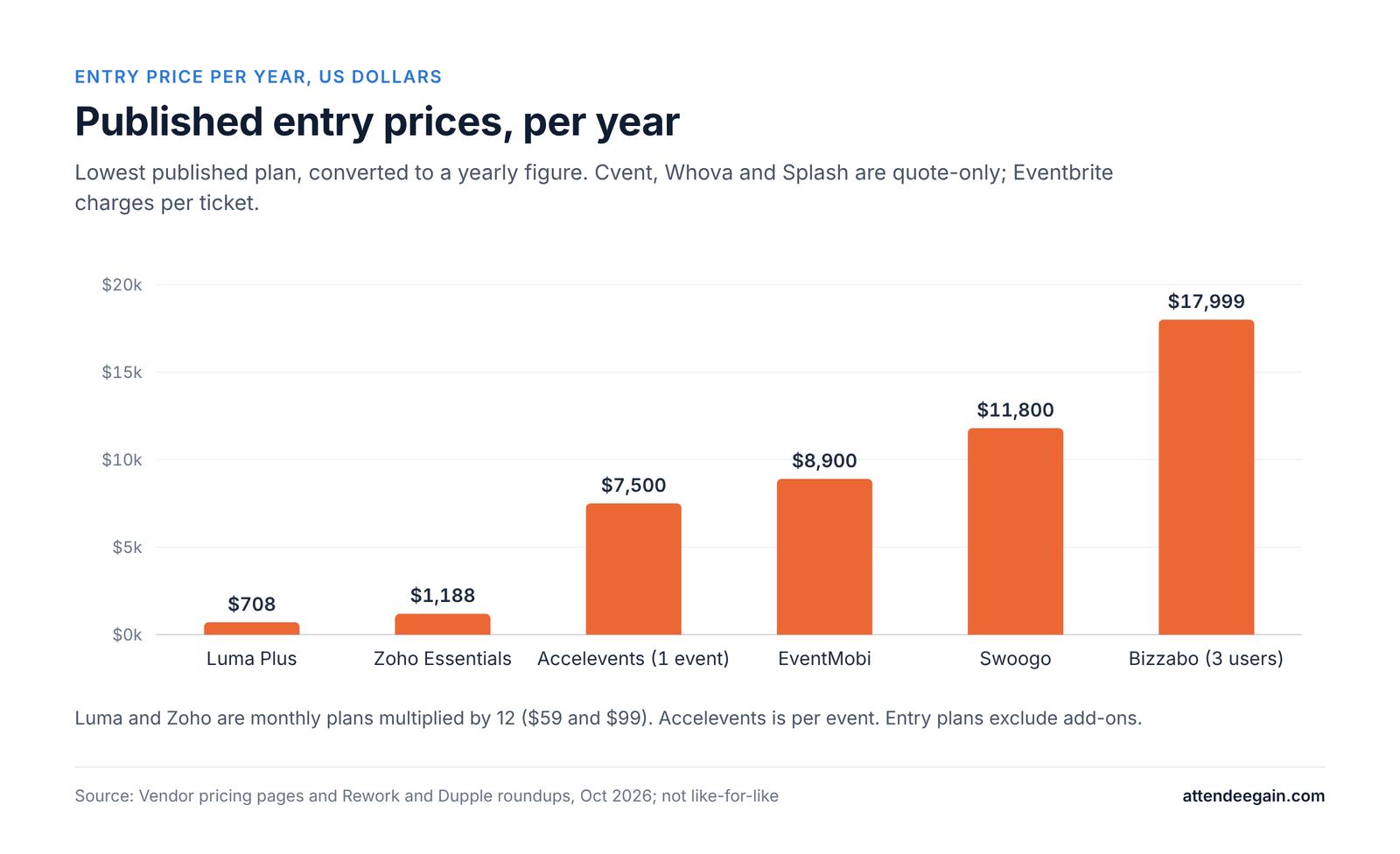
| Platform | Published price | Model |
|---|---|---|
| Cvent | None (estimates $19,600 to $79,000+/yr) | Quote; modules and registrants |
| Bizzabo | $499/user/month, 3-user minimum | Per user |
| Swoogo | From $11,800/yr | Per user, unlimited registrations |
| Eventbrite | Free events free; paid tickets 3.7% + $1.79 + 2.9% processing; Pro from $15/month | Per ticket |
| Whova | None | Quote |
| Splash | None (estimates $12,500 to $36,500+/yr) | Quote; user licenses |
| Accelevents | From $7,500 (1 event); $13,500 (unlimited) | Plan |
| EventMobi | $3,000/event or $8,900/yr | Per event or annual |
| Zoho Backstage | Free to 100 attendees; $99/month or $299/event | Per event or monthly |
| Luma | Free (5% on paid tickets); Plus $59/month yearly | Free plus fee |
Estimates come from third-party roundups, not the vendors.
What a ticket fee costs
On a $50 Eventbrite ticket, 3.7% is $1.85, the fixed fee is $1.79 and 2.9% processing is $1.45, so about $5.09, or roughly 10% of the ticket. On a $20 ticket it is $0.74 + $1.79 + $0.58 = $3.11, about 16%. Per-ticket models are cheap when you sell few expensive tickets and costly when you sell many cheap ones. Flat-license tools such as Swoogo or Accelevents flip that.
Costs the price lists leave out
- Implementation or build services.
- Badge printers, kiosks and paper.
- Payment processing on top of the platform fee.
- Extra seats, since per-user pricing grows with your team.
- Renewal increases; ask for a cap in writing.
- Your team’s hours.
How to choose event management software
- Count your events and attendees. Under ten events a year, avoid heavy enterprise suites. Over fifty, per-ticket and per-event pricing gets expensive.
- Pick the event type. Public ticketed, B2B conference, association meeting, field marketing and internal events need different tools.
- List must-haves. Registration rules, payments, app, onsite check-in and badges, sponsor and exhibitor tools, virtual streaming, languages and currencies.
- List the systems it must feed. CRM, marketing automation, finance, SSO. Ask the vendor to show the data moving, not just claim an integration.
- Ask for security documents early. SOC 2 report or equivalent, data residency, retention and deletion terms.
- Price the scenario. Ask each shortlisted vendor to quote the same scenario, itemized.
- Run a pilot. Use a smaller event before committing to a flagship.
Where implementations go wrong
- Starting too late. Registration rules, payments and integrations need testing time, and onsite needs a rehearsal.
- Buying for features you will not use. Switching later is costly.
- Treating the integration as done when it connects. Test field mapping, duplicates, refunds and cancellations.
- Ignoring onsite. Badge printing, Wi-Fi, hardware and staff training sink more event days than software bugs.
- No owner after launch. Someone must own the platform, reports and renewals.
If you want help with any of this, see our event registration platforms page.
FAQ
What is the best event management software? There is no single best. Cvent suits enterprise programs, Bizzabo flagship conferences, Swoogo registration-heavy events, Eventbrite public ticketing and Whova attendee networking.
What is the cheapest event management software? Eventbrite is free for free events, Luma is free with a 5% fee on paid tickets, and Zoho Backstage is free up to 100 attendees. The cheapest for you depends on ticket prices and volume.
How much does event management software cost? From free to tens of thousands of dollars a year. Published entry prices in this list run from free to about $18,000 a year, and several enterprise tools publish no price.
What is the difference between event management and event registration software? Registration software handles sign-up, payments and check-in. Event management software adds the app, agenda, sponsors, reporting and often venue sourcing.
Do I need an event app? For multi-track conferences, usually. For a single-room event, a mobile-friendly agenda page may be enough.
How long does implementation take? From days for a simple ticketed event to months for an enterprise rollout. Plan back from your first event date.
Need help choosing or implementing?
AttendeeGain implements Cvent, Bizzabo, Swoogo, Splash and Whova and can help you shortlist and set up the right platform. Start with our Cvent expertise, Bizzabo expertise, Swoogo expertise, Splash expertise and Whova expertise, or contact us.
Sources: Cvent, Bizzabo, Swoogo, Eventbrite and Accelevents pricing pages.