Bizzabo vs Swoogo: the short answer
Bizzabo vs Swoogo is a choice between a better room and a better registration form.
Choose Bizzabo if the onsite experience is the point: networking, sponsor leads and engagement data, especially with its Klik SmartBadge wearables. Choose Swoogo if registration is the point: complex, branching forms, frequent events and a team that wants to build everything itself without paying for hardware it will not use.
Both sit in the same middle ground. They are more capable than ticketing tools like Eventbrite, and neither offers Cvent-style venue sourcing. Both include unlimited events and registrations. The difference is where each one puts its depth: Bizzabo at the event itself, Swoogo at the form the attendee fills in before they arrive.
We build on both. Below, we check each vendor’s claims against the other’s published pricing, because some of what you will read online does not hold up.
Bizzabo vs Swoogo at a glance
| Bizzabo | Swoogo | |
|---|---|---|
| Built for | B2B marketing teams running flagship conferences | Event producers who own registration and the event website |
| Published price | $499 per user per month, billed annually, 3-user minimum ($17,999 a year) | Professional US$11,800 a year; Enterprise custom |
| Users at that price | 3 | 1 full user and 1 reporting user |
| Events and registrations | Unlimited | Unlimited |
| Signature strength | Klik SmartBadge networking and lead capture | Unlimited conditional logic on every plan |
| Attendee mobile app | Included; custom-branded app is an add-on | Go Attend, an add-on |
| Check-in app | Onsite Command App listed in the core plan; Advanced Onsite is an add-on | Go Onsite included; Go Onsite Pro is an add-on |
| CRM and martech integrations | Add-on | 30+ integrations included |
| Virtual production | Streaming studio, simulive, breakout rooms | Event Hub plus your own streaming provider |
| Venue sourcing | No | No |
Bizzabo vs Swoogo feature-by-feature
Registration and event websites
This is Swoogo’s home ground. Unlimited conditional logic runs across forms, emails and web pages on every plan, so one question can show or hide a dozen later fields, and different attendee types can see different content on the same site. Bizzabo’s registration flows, ticketing and website builder are capable and fast to stand up, and its advanced registration flows are in the core plan. For a typical B2B conference, both work. For forms that branch on many variables, Swoogo is the safer bet.
Onsite, badging and Klik
This is where they split. Swoogo’s Go Onsite check-in app is included, with offline check-in; Go Onsite Pro adds kiosk mode. Bizzabo offers check-in through its Onsite Command App, rentable Bizzabox kits and technicians, plus Klik SmartBadge wearables. Klik lets attendees swap contact details with a tap, lets exhibitors capture leads without a scanner, and shows organisers which sessions and booths drew a crowd. Swoogo has nothing equivalent.
Networking and matchmaking
Bizzabo has two layers: Klik for casual tap-based introductions, and a Networking add-on for 1:1 scheduling and smart matchmaking. Swoogo supports 1:1 and one-to-many meetings and integrated chat, but structured matchmaking is lighter. If matchmaking is a hard requirement, test it on Swoogo before you sign.
Virtual and hybrid
Bizzabo includes a streaming studio with simulive sessions and breakout rooms, and sells a fuller Virtual Event Experience as an add-on. Swoogo’s Event Hub gives virtual attendees a branded space, with video from your own provider. Choose Bizzabo if you want one vendor running the production; choose Swoogo if you already have a streaming tool you like.
Integrations
Swoogo includes 30+ integrations in Professional, with no integration fees. Bizzabo lists martech and CRM integrations, including HubSpot, Marketo, Salesforce MCAE and Eloqua, as a paid add-on. If CRM sync is essential, Swoogo’s headline price is closer to the real price.
Bizzabo vs Swoogo pricing: the numbers worked out
Both vendors publish real prices, which is rare in this category. But “unlimited” means unlimited events and registrations, not unlimited users.
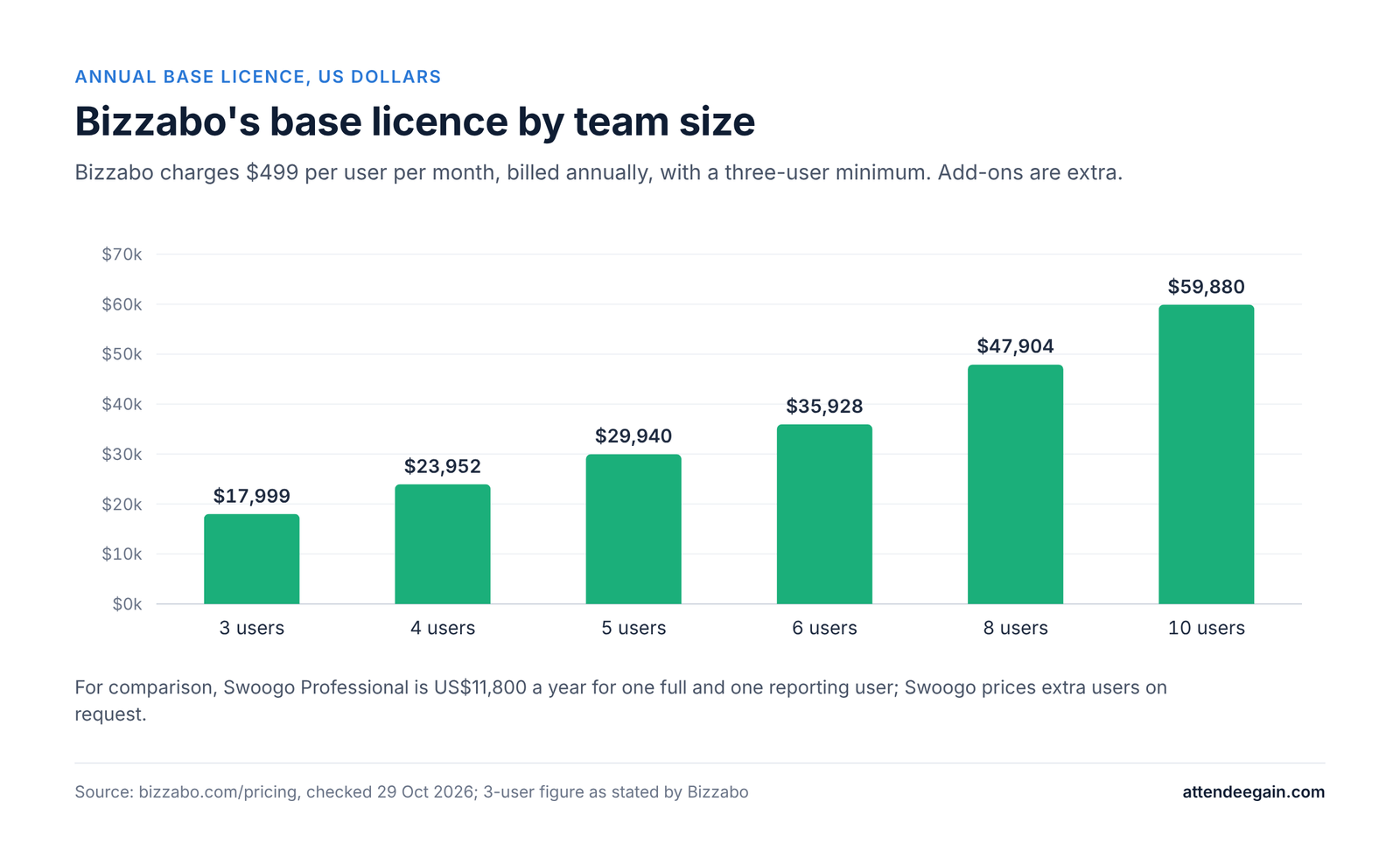
Bizzabo charges $499 per user per month, billed annually, with a minimum of three users. Because the per-user rate is public, you can work out the base licence for any team size:
| Team size | Bizzabo base licence per year |
|---|---|
| 3 users (minimum) | $17,999 (Bizzabo’s stated figure) |
| 5 users | about $29,940 |
| 10 users | about $59,880 |
Add-ons then sit on top: martech and CRM integrations, sponsor and speaker portals, networking, a custom-branded app, API access, SSO, branding, Advanced Onsite, virtual production and Klik.
Swoogo Professional is US$11,800 a year and includes one full user and one reporting user. Swoogo prices extra users on request and does not publish the per-user rate, so a five-person team should expect a higher number and ask for a written quote. Upgrades include Go Onsite Pro, the Go Attend app, premium support, pro services, extra domains, SSO, sub-accounts and Call for Speakers.
A claim to check. Swoogo’s comparison page says Bizzabo charges per registration plus setup, integration and support fees. Bizzabo’s own pricing page lists unlimited registrations in its base plan. On Bizzabo’s current published pricing, the per-registration claim does not hold, though its integration add-on is real. Ask both vendors to put their fee structure in writing.
| Cost line to ask about | Bizzabo | Swoogo |
|---|---|---|
| Extra team members | $499 per user per month | Priced on request |
| CRM integrations | Add-on | Included |
| Attendee app | Included; branded app is an add-on | Go Attend add-on |
| Kiosk or advanced onsite | Advanced Onsite add-on, Bizzabox rental | Go Onsite Pro add-on |
| Wearables | Klik, quoted per event | Not offered |
| SSO | Add-on | Add-on or Enterprise |
Bizzabo vs Swoogo implementation and support
Bizzabo includes a structured onboarding plan, a dedicated Event Success Specialist, pre- and post-event success calls and 24/7 support. It says new customers typically drive registration to their sites and apps within two months. The heaviest work is deciding which add-ons your programme needs before the first event, not after.
Swoogo says a first event can be built in a day, and its in-house support promises a first response within 15 minutes in business hours. The heaviest work is designing conditional logic up front: mapping who sees which question, page and email before anyone starts building.

On G2, as published by Swoogo in July 2026, Swoogo scored 9.7 for ease of use against Bizzabo’s 8.6, and 9.9 for quality of support against 8.9. Both are strong; Swoogo leads on both measures.
What stalls rollouts:
- Bizzabo: CRM sync, SSO or Klik discovered as extras after signing; Klik ordered too late for the event date.
- Swoogo: a team of four signing a two-seat plan; logic built page by page without a plan, so later changes break earlier branches.
Sponsors and exhibitors
Bizzabo includes lead management, sponsored sessions and app branding in the core plan, sells a sponsor portal as an add-on, and has Klik for tap-based lead capture and booth-traffic data. For sponsor-heavy conferences, that combination is hard to beat.
Swoogo offers customisable sponsor pages, tailored sponsor registration and communications, 1:1 meetings and reports on individual attendee interactions. It is solid for sponsor logistics but has nothing like Klik for capturing leads on the show floor.
AI features in 2026
- Bizzabo has an organiser assistant, Event OS Copilot (November 2024), and an attendee assistant, Bizzy (April 2026), which answers questions about sessions, speakers and logistics. Matchmaking uses registration and engagement data.
- Swoogo launched an MCP server in March 2026 so AI assistants such as Claude, ChatGPT and Gemini can query live event data and make some updates. Rule-based automations are included in Professional.
Bizzabo puts AI in front of attendees; Swoogo puts event data in front of your team’s AI tools.
Bizzabo vs Swoogo security and compliance
| Bizzabo | Swoogo | |
|---|---|---|
| SOC 2 Type II | Yes | Yes |
| ISO 27001 | Yes | Yes, plus ISO 27701 |
| PCI DSS | Not listed on its pricing page | Level 1 |
| GDPR and CCPA | Yes | Yes |
| Organiser SSO | Add-on | Add-on or Enterprise |
| Uptime SLA | Ask in your contract | 99.9%, Enterprise plan |
Reliability
Bizzabo publishes a 99.99% uptime figure for the first half of 2025 on its own comparison page. Swoogo’s Enterprise plan carries a 99.9% uptime SLA with compensation. A published figure and a contractual SLA are different things, so ask Bizzabo whether its figure is backed by an SLA in your contract, and ask Swoogo whether its SLA applies on Professional.
Switching between Bizzabo and Swoogo
Data moves; builds do not. Moving from Bizzabo to Swoogo means rebuilding registration with conditional logic, which is usually an upgrade, and deciding what replaces Klik. Bizzabo says Klik works with third-party platforms, so keeping it for a flagship event is an option. Moving from Swoogo to Bizzabo means checking that every branch of your current forms can be rebuilt, and pricing the add-ons you will need.
Bizzabo vs Swoogo: which should you choose?
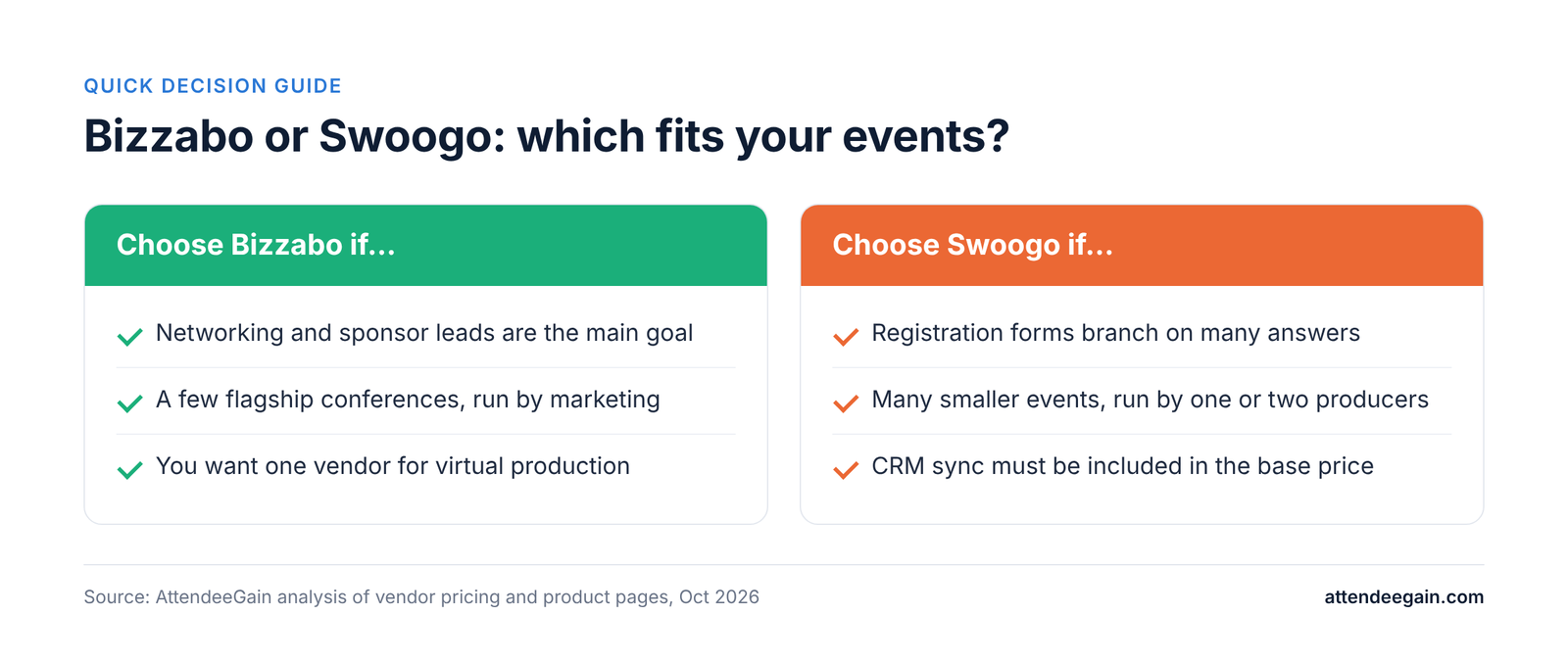
| Your situation | Better fit | Why |
|---|---|---|
| Networking and sponsor leads are the main KPI | Bizzabo | Klik wearables and the Networking add-on |
| Registration forms branch on many answers | Swoogo | Unlimited conditional logic on every plan |
| A few flagship conferences, run by marketing | Bizzabo | Built around the onsite experience |
| Many smaller events, run by one or two producers | Swoogo | Two seats and unlimited events from US$11,800 |
| CRM sync must be in the base price | Swoogo | 30+ integrations included |
| One vendor for virtual production | Bizzabo | Built-in streaming studio |
| You need venue sourcing or room blocks at scale | Neither | Look at Cvent |
If you are torn, decide which part of the event you are actually trying to fix: the form attendees fill in, or the room they walk into.
Bizzabo vs Swoogo FAQs
Is Swoogo cheaper than Bizzabo? For small teams, usually. Swoogo starts at US$11,800 a year for two seats; Bizzabo starts at $17,999 a year for three. As the team grows, Bizzabo’s cost is easy to calculate from its public rate, while Swoogo’s extra seats need a quote.
Does Bizzabo charge per registration? Not on its current published pricing, which includes unlimited events and registrations. Its add-ons, such as CRM integrations and Klik, are where costs rise.
Does Swoogo have anything like Klik? No. Swoogo’s onsite layer is the Go Onsite check-in app, with a Pro upgrade for kiosk mode.
Which has better registration logic? Swoogo. Unlimited conditional logic across forms, emails and pages is its core strength.
Do either of them do venue sourcing? No. For venue sourcing and hotel room blocks at scale, Cvent is the main option.
Can I buy either one for a single event? Both sell annual subscriptions. Bizzabo states it requires an annual subscription.
Sources: Bizzabo pricing, Swoogo pricing, Swoogo vs Bizzabo, Bizzabo: Cvent vs Bizzabo.
Need help deciding?
We build on Bizzabo and Swoogo. Talk to our team and we will help you price your real team size and pick the platform that fits. See our Bizzabo expertise and Swoogo expertise pages, or explore our event registration platforms and onsite solutions pages.