The Presence Premium is the rising value of genuine human connection in an AI-first world. As AI makes content, outreach and personalization infinitely scalable — and infinitely easy to fake — a room full of real people becomes worth more, not less. Cvent introduced the term at CONNECT 2026, but the underlying economics apply to any organization that runs events, regardless of which platform it uses.
Key Takeaways
- Cvent introduced “The Presence Premium™” as its new brand platform on July 14, 2026, at Cvent CONNECT in Nashville.
- 98% of marketers and event professionals say in-person and community-based events sit central to their marketing strategy (Cvent-commissioned research).
- A Forrester Consulting study of 459 event-owning leaders found that 70% say events matter more, not less, as AI floods channels with synthetic content.
- The same study found 72% say deals close faster when prospects attend in person.
- Separate Censuswide research found 85% say AI-generated content makes trust harder to build, and 81% say attending an in-person event increased audience trust.
- The thesis has a real critique, too. Cvent spent $700 million on virtual event platforms — Goldcast and ON24 — the same year it branded around in-person presence. We cover that tension below.
Where the Term Comes From
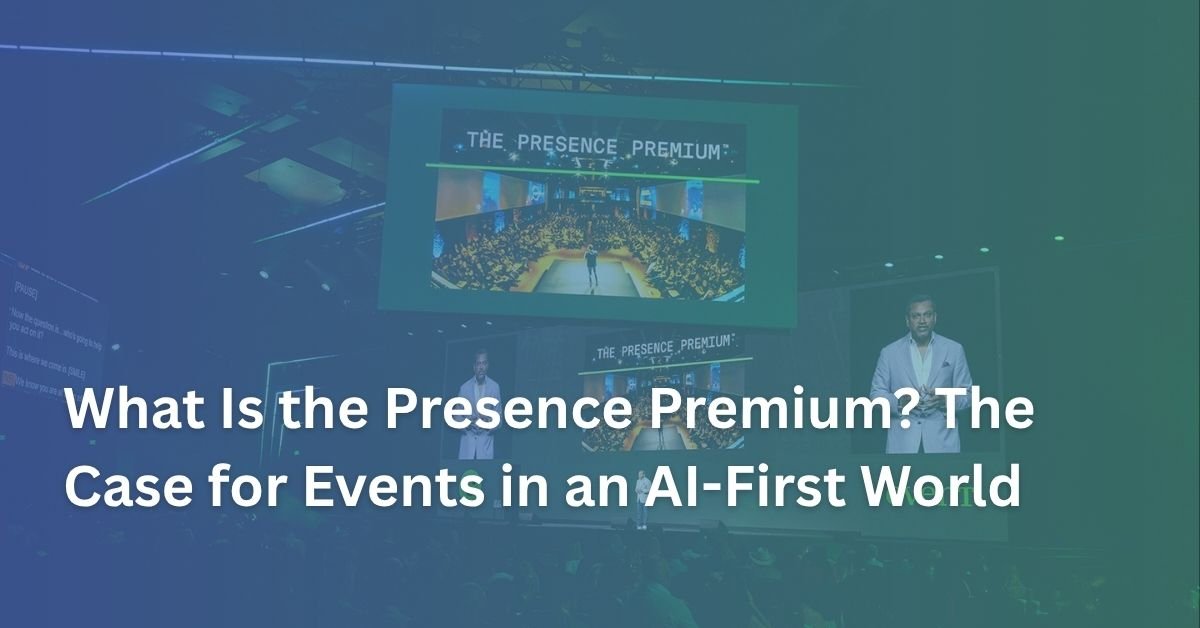
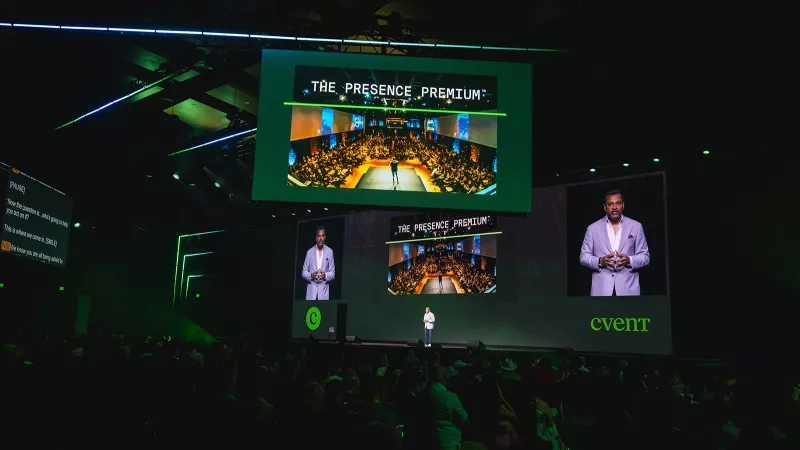
Cvent unveiled “The Presence Premium™” as a new brand platform at Cvent CONNECT 2026, alongside a $1 billion product-investment pledge. CEO Reggie Aggarwal introduced the idea in the opening keynote. “In a world where AI can generate almost anything, people are craving something real,” he said.
Cvent doesn’t just coin a phrase here. The company backs it with three separate research efforts, run either directly by Cvent or by outside firms on its behalf.

The Economic Argument, Plainly
Strip away the branding, and the logic holds up on its own. AI pushes the marginal cost of content, outreach and personalization toward zero. Anyone can generate a polished email, a synthetic video, or a personalized pitch in seconds now. That abundance cuts two ways.
It lets marketers reach more people for less money. But it also erodes trust — when everything looks curated and nothing costs real effort, audiences learn to discount it. Scarcity creates value. And the scarcest thing left in a world of infinite content is a real room full of real people.
Three independent data points back this up:
- Forrester Consulting surveyed 459 event-owning leaders on behalf of Cvent. 70% said events matter more, not less, as AI floods every channel with synthetic content. 72% said deals close measurably faster when prospects attend.
- Censuswide fielded a separate study in March 2026 across roughly 900 marketers and event professionals. 85% said AI-generated content makes it harder to build audience trust. 81% said trust increased after an in-person event.
- Cvent’s own commissioned research puts the number at 98% — the share of marketers and event professionals who call in-person and community-based events central to their marketing strategy.
Three different research firms surveyed three different pools of people, and they landed on the same pattern. That consistency matters more than any single number does.
The Skeptic's Case
Not everyone buys the narrative cleanly, and the counterargument deserves a direct airing. Cvent spent roughly $700 million in December 2025 acquiring two virtual and webinar platforms, Goldcast and ON24. Seven months later, it built its entire brand identity around the superiority of in-person presence. Critics have called that sequencing a paradox — a company doubling down on virtual infrastructure while marketing the opposite message.
There’s a fair measurement critique too. Cvent can describe the Presence Premium qualitatively — trust, recall, deal velocity — but it hasn’t yet attached a firm dollar figure to it. The concept describes a real, well-supported trend. It isn’t a precise valuation model yet.
Both things can be true at once. The underlying shift toward valuing real presence holds up well. And Cvent’s own positioning carries some obvious self-interest, since it sells the software that enables presence-driven events.
The Presence Premium Scorecard: Measure Your Own Events
Here’s an original framework we built at AttendeeGain to help you assess how much presence premium your own events actually capture — not just how compelling the concept sounds on a keynote slide. Score each dimension from 1 (not at all) to 5 (fully), then add up your total out of 25.
- Irreplaceable moments. Could an AI-generated video or a webinar have delivered this content just as well?
- Unscripted trust-building. Does your event create real, unscripted moments — open Q&A, hallway time, 1:1 conversations — where trust builds in real time?
- Scarcity and access. Does attendance feel earned or limited, rather than passively available to anyone with a link?
- Post-event conversion speed. Do you track whether deals or next steps move faster for attendees than for people who didn’t attend?
- Trust measurement. Do you actually measure trust and relationship signals tied to attendance — sales-cycle length, deal velocity, NPS — instead of just registration counts?
Score interpretation:
- 5–10: Vulnerable to AI substitution. Content could largely replace your event. Rethink what only presence can deliver.
- 11–18: Building the premium. Real moments of value exist, but you aren’t measuring or amplifying them yet.
- 19–25: Capturing the full presence premium. Your event creates trust AI can’t replicate, and you can prove it with data.
How to Actually Capture the Presence Premium
Knowing the concept doesn’t create the value. Three practical moves do:
- Design for unscripted time, not just a packed agenda. Hallway conversations and open Q&A are where trust actually builds — protect space for them.
- Track deal velocity, not just attendance. If you can’t show attendees closing faster or churning less than non-attendees, you can’t prove the premium exists in your program.
- Report presence as a metric, not a mood. Put sales-cycle and trust data in the same report as registration numbers. That’s how leadership sees the connection Forrester’s research shows industry-wide.
That last step is where most event programs fall short — and it’s exactly what we help clients build. See our full framework for proving event ROI to your CFO.
For the context behind why Cvent built its whole brand around this idea, read our breakdown of why Cvent rebranded in 2026. For everything else the company announced alongside it, check the full Cvent CONNECT 2026 roadmap hub.
FAQs
What is the Presence Premium? The Presence Premium is the rising value of genuine human connection in an AI-first world. Cvent introduced the term at CONNECT 2026, arguing that as AI makes content and outreach infinitely scalable, in-person gatherings become more valuable, not less.
Who coined the term “Presence Premium”? Cvent introduced “The Presence Premium™” as a trademarked brand platform at Cvent CONNECT 2026, alongside a $1 billion product-investment pledge. CEO Reggie Aggarwal introduced the concept in the event’s opening keynote.
What data supports the Presence Premium concept? Three separate research efforts back it. Forrester Consulting found that 70% of event-owning leaders say events matter more, not less, as AI spreads synthetic content, and 72% say deals close faster when prospects attend. Censuswide research found 85% say AI-generated content makes trust harder to build, and 81% say trust increased after an in-person event. Cvent’s own research puts the figure at 98% of marketers who call in-person events central to their strategy.
Is the Presence Premium just marketing from Cvent? Partly — and it’s fair to note the self-interest, since Cvent sells the software that enables presence-driven events. But the underlying data comes from three independent research firms across different survey pools, and the broader trend holds up on its own: trust in AI-generated content is falling, and verified human interaction is gaining value regardless of Cvent’s branding.
How can I measure the Presence Premium for my own events? Score your program against five factors: irreplaceable moments, unscripted trust-building, scarcity of access, post-event conversion speed, and whether you measure trust signals at all. The Presence Premium Scorecard above walks through each one.