Cvent rebranded in 2026 from a position of strength, not weakness. The move unifies a $700M+ acquisition spree under one identity. It sharpens an investor story ahead of a likely re-listing. And it plants a flag on the boldest idea in event technology today: the Presence Premium — the argument that in an AI era, being physically present becomes more valuable, not less.
It may be the most powerful message the event-tech giant has ever sent. It reframes AI from a threat to events into the very reason events matter.
At AttendeeGain, we implement Cvent — along with Bizzabo, Hubilo, RainFocus and others — for organizations worldwide. So we read the Cvent rebrand as practitioners, not cheerleaders. Here’s why it happened, why it lands so hard, and why the Presence Premium is the idea to watch this decade.
Why did Cvent rebrand? Follow the money
The common assumption is that a rebrand signals a company in trouble. Here, that assumption runs backwards. The real story is corporate finance, and it reads as offense.
Blackstone took Cvent private in a $4.6 billion deal in 2023. Blackstone then bought out the remaining stake for roughly $1.3 billion in July 2025, taking full ownership. In December 2025, Cvent spent about $700 million in a single month on two acquisitions — Goldcast (~$300 million) and ON24 ($400 million, at a reported 62% premium). Industry observers read the full-ownership consolidation, plus the buying spree, as a move to clear the deck for a potential re-listing at a higher valuation.
So when people ask why Cvent rebranded, the honest answer is that a rebrand does three things a fast-moving consolidator needs:
- Unify the acquisitions. After absorbing ON24, Goldcast and others, Cvent needed one brand and one narrative. That’s the “everything under one hood” logic behind the new Unified Event List.
- Sharpen the equity story. “Performance,” a $1 billion AI investment, “the highest-performing events on the planet” — that’s language that targets investors as much as customers.
- Plant a flag on the AI-and-events narrative before anyone else does. That flag is the Presence Premium — and it’s the part worth dwelling on.
Why It's the Most Powerful Message in Event Tech
Plenty of companies rebrand. Few say anything. The Cvent rebrand lands because it takes a clear, contrarian position at the exact moment the whole industry worries about the same thing: what AI does to human attention.
Most software companies race to tell you AI will automate everything. Cvent’s message runs the opposite way — as AI automates everything, the unautomatable becomes premium. That’s a message with a point of view, and real numbers back it up, not just vibes:
- Morgan Stanley AlphaWise expects only about 8% of travel volume to shift permanently virtual in 2026. That’s down from as high as 29% in surveys over the prior four years.
- Global meeting RFP activity hit 102% of 2019 levels in Q2 2025 — the strongest quarterly result since tracking began.
In other words, the substitution fear that shadowed events for five years has largely failed to materialize. Nothing is replacing live events. They keep reclaiming ground instead. And a company betting against events wouldn’t spend the way Cvent just has — the message works because the data underneath it is real.
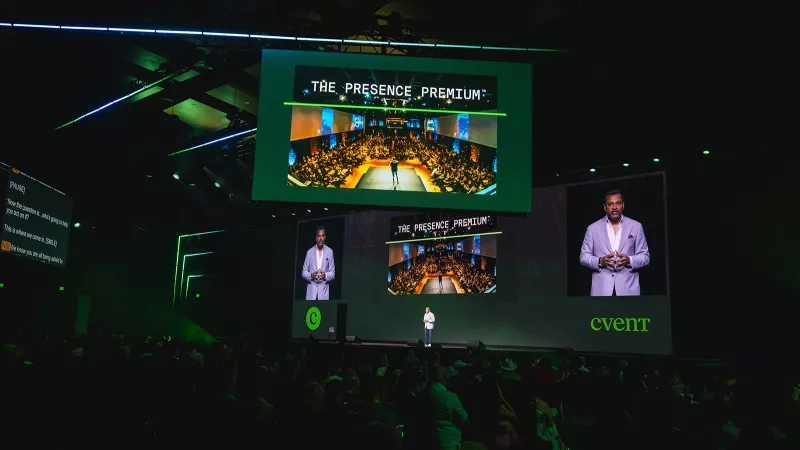
The Presence Premium: the future in the AI era
Here is the idea the entire Cvent rebrand is built around.
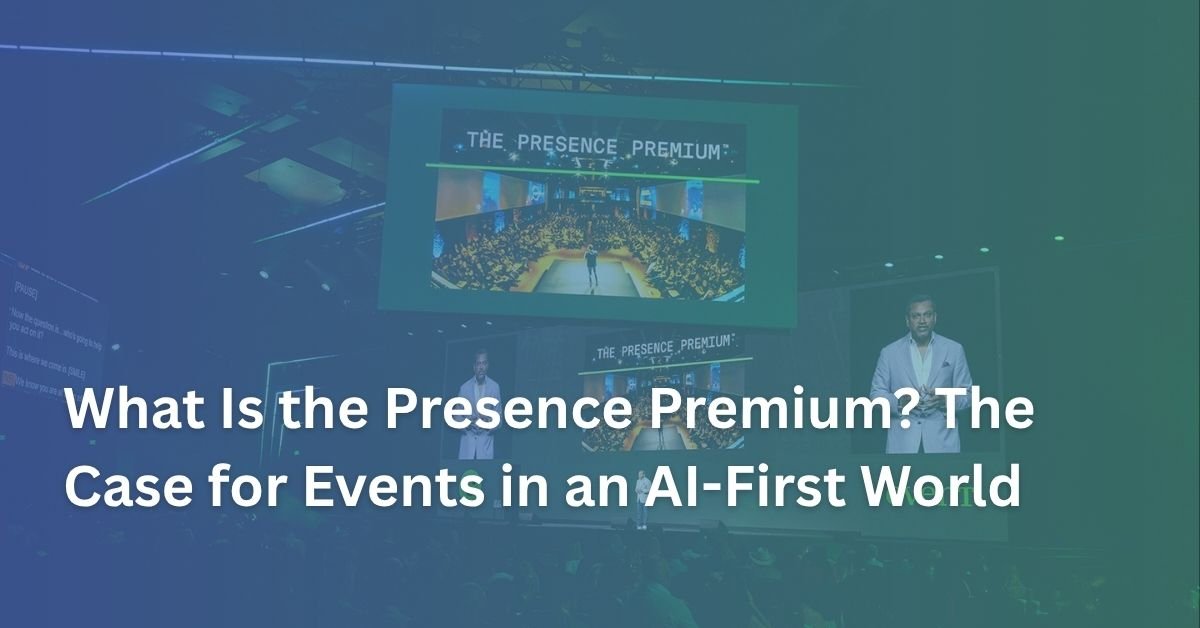
The Presence Premium is the rising value of genuine human connection in an AI-first world — the idea that the more content, outreach and personalization AI makes infinitely scalable and infinitely fake-able, the more a room full of real people is worth.
It’s a clever inversion. It takes the biggest open question over event tech — does AI make gathering less necessary? — and turns it into the argument for why events matter more. As AI-generated content floods every channel and audiences grow more skeptical of it, the scarce, trusted, high-signal moment is the one that happens in a real room. Cvent’s bet is that AI and events become the two biggest drivers of business performance this decade: AI supplies speed and scale, events supply trust and connection, and the combination produces outcomes neither delivers alone.
That’s why the new brand pairs AI with presence rather than setting one against the other, and why “performance” sits at its center. For event professionals, the takeaway is bigger than one company’s logo: presence is becoming a measurable competitive advantage, and the teams that can prove it will win budget over the teams that can’t.
The industry backdrop: not shrinking — growing
The Presence Premium only works as a thesis because the underlying market supports it. It does.
- The broad events industry is valued at roughly USD 1.46 trillion in 2026 and is projected to reach about USD 2.08 trillion by 2030, growing near a 9.3% CAGR (The Business Research Company; Research and Markets).
- The narrower MICE segment — meetings, incentives, conferences and exhibitions, Cvent’s core — sits somewhere between $1.14 trillion and $1.34 trillion in 2026 depending on the research house, growing 7–11% annually (Precedence Research, Grand View Research, Fortune Business Insights).
- Analysts describe recovery from the 2020–2022 contraction as complete, with the sector entering its strongest expansion phase in a decade.
A note for anyone quoting these figures: estimates vary widely by source and methodology, so cite a range, not a single headline number. The direction, though, isn’t in dispute.

The real pressure isn't survival — it's ROI
Even in a growing market, buyers are cautious, and that shapes the “performance” messaging as much as anything.
Recent surveys show cautious optimism — around 57% of event professionals expect favorable conditions and 60% predict higher meeting attendance (MPI Meetings Outlook), but budgets are only mildly favorable and many teams are adjusting strategy for economic and political uncertainty. The result is relentless pressure to prove event ROI — to connect spend to pipeline and revenue for CFOs and boards. The Cvent rebrand’s whole “outcomes” framing is built for that conversation. It’s also the single most important capability event teams should be investing in right now, regardless of which platform they run.
The future of events: global, US, and Europe
Globally, the story is structural growth with the center of gravity shifting east and south. Asia-Pacific is the fastest-growing major region and is expected to overtake Europe by 2030, while the Middle East and Africa grow fastest — roughly 11.4% annually — on the back of venue investment in Saudi Arabia and the UAE. India, the UAE, Saudi Arabia and Singapore are the momentum markets.
United States — a “yes, but” market. Group demand and RFPs are back above pre-pandemic levels, and 2026 is widely viewed as the start of a new growth phase, with private-sector meeting activity resilient even as government-related meetings fell sharply in 2025. But raw business-travel spend is growing slowly: the U.S. Travel Association forecasts US business travel up just 0.7% in real terms in 2026 to about $319 billion, with stronger recovery from 2027 onward. The headwind to watch is policy friction — 38% of meeting buyers say they’re less likely to host multinational meetings in the US than six months ago, citing visa complexity and political climate (Skift Meetings).
That caution shows up starkly by region. According to Northstar Meetings Group and Cvent’s own PULSE data, 38% of North American planners felt less optimistic about the industry than at the start of the year, with only 24% more optimistic — while in EMEA, 50% of planners felt more optimistic and just 28% less. The sentiment gradient runs in Europe’s favor.
Europe — the incumbent giant, still the largest MICE region at roughly half of global market revenue in 2025, though growing more slowly than emerging regions. Two things make it a near-term winner. First, corporate travel budgets are projected to rise about 5% globally in 2026, with European companies leading the expansion (Morgan Stanley). Second, Europe is the natural beneficiary of the US multinational-meeting pullback. The nuance worth understanding: much of Europe isn’t uniformly booming so much as concentrating — spend is consolidating around events with a clear reason to exist, like the flagship trade show and the industry congress. Germany alone accounts for around 27% of the European MICE market.
What this means if you run events
Three takeaways for planners and marketers reading past the rebrand:
- Don’t wait out a “downturn” that isn’t happening. The market is expanding; the risk is under-investing, not over-investing.
- The platform race is now an AI-and-consolidation race. Whichever tool you use, the differentiator is no longer features — it’s whether your stack is unified and whether you can prove outcomes.
- Presence is now a metric, not a mood. If you can’t connect an event to pipeline, you’ll lose the budget argument regardless of how good the event was.
FAQs
Why did Cvent rebrand in 2026? Primarily to unify a wave of acquisitions (including ON24 and Goldcast), strengthen its investor narrative ahead of a possible re-IPO under Blackstone ownership, and stake out the Presence Premium position before competitors do. It’s a move made from strength, not distress.
What is the Presence Premium? The Presence Premium is the rising value of genuine human connection in an AI-first world — the argument, central to the Cvent rebrand, that as AI makes digital content and outreach infinitely scalable, in-person gatherings become more valuable, not less.
Why is the Cvent rebrand considered such a strong message? Because it takes a clear, contrarian position — that AI increases the value of presence rather than replacing it — and backs it with data showing in-person events reclaiming share from virtual, at a moment when most software companies are saying the opposite.
Is the event industry growing in 2026? Yes. The broad events industry is around $1.46 trillion in 2026, projected to reach roughly $2.08 trillion by 2030 at about a 9.3% CAGR, and recovery from the pandemic-era contraction is considered complete.
Will AI replace in-person events? Unlikely, and current data cuts the other way: only about 8% of travel volume is expected to shift permanently virtual in 2026, down from as much as 29% in earlier surveys, while meeting RFP activity has surpassed pre-pandemic levels.