Cvent vs Whova: the short answer
Cvent vs Whova is a choice between a full event lifecycle platform and an attendee-app-first tool. Here is how they compare on features, pricing, setup and fit, written from the point of view of an implementation partner.
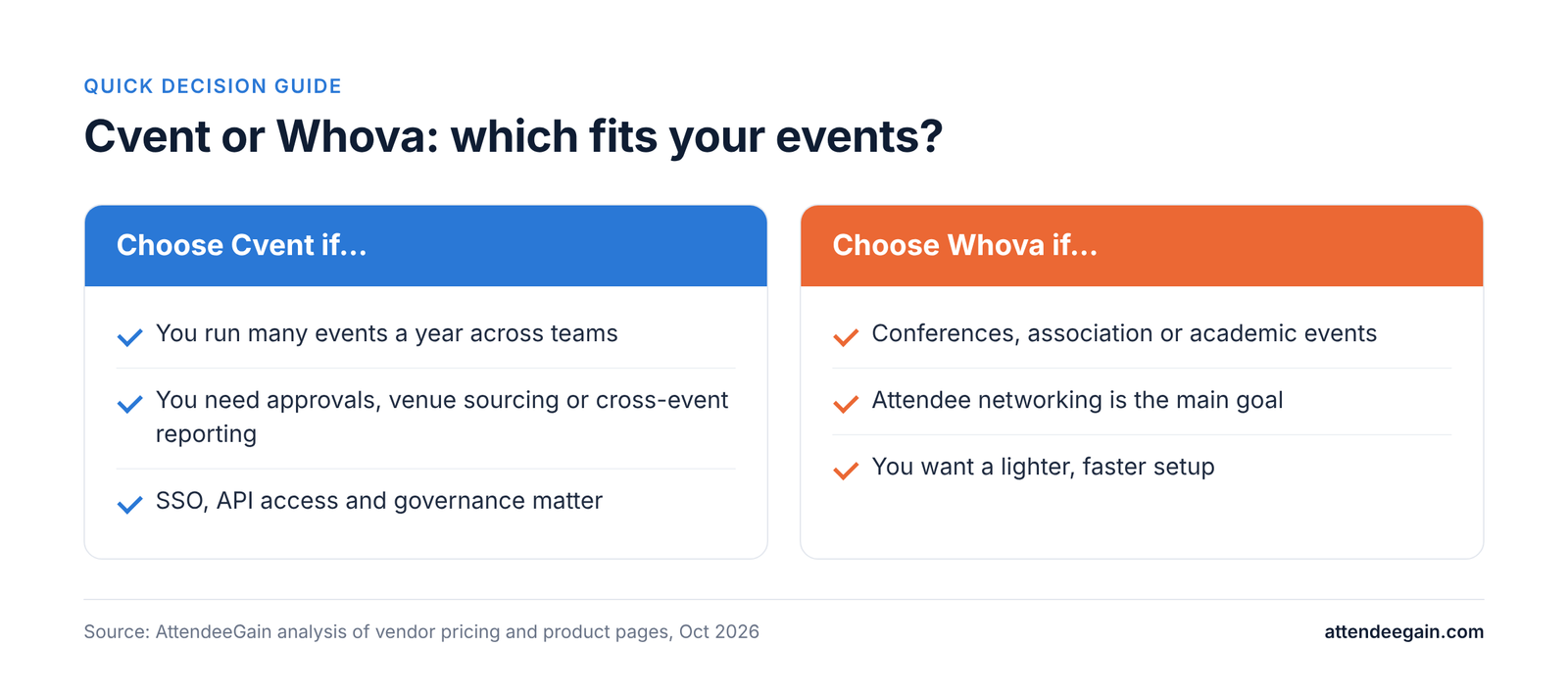
Choose Cvent if you run a portfolio of events and need registration, venue sourcing, onsite, approvals and reporting inside one governed system. Choose Whova if you run conferences, association meetings or academic events where the attendee app and networking do most of the work, and you want a lighter setup.
The two are priced differently, not just at different levels. Cvent licenses modules (Registration, Attendee Hub, OnArrival) on a quote. Whova publishes no prices at all and quotes by event size and add-ons. Neither can be compared on a list price, so the pricing section below works from what each vendor says it charges for and what third parties report.
| Cvent | Whova | |
|---|---|---|
| Best for | Enterprise event programs, many events a year | Conferences, associations, academic and nonprofit events |
| Strongest at | End-to-end lifecycle, onsite, approvals, reporting | Attendee app, networking, simple setup |
| Pricing model | Quote; modules licensed separately; Professional or Enterprise tier | Quote by event type, duration and attendee count |
| Published prices | None | None |
| Admin effort | Higher; usually needs a trained admin or partner | Lower |
| Watch out for | Add-ons, per-registrant fees and renewal uplift | Add-on costs for registration and badging, no price visibility |
Cvent vs Whova: feature by feature
Registration and ticketing
Cvent Registration is a separate licensed solution. It handles multiple attendee types, approvals, conditional logic and payments, and it is the part teams most often need help configuring. Whova offers Registration & Ticketing as an add-on to its event app, with instant payouts for paid events. For a single conference with a few ticket types, Whova is quicker to stand up. For events with approval chains, group bookings or purchase orders, Cvent has more depth.
Event app and attendee engagement
This is Whova’s home ground. Its app is built around the agenda, attendee profiles, networking and community features, and independent roundups consistently rate it highly for engagement. Cvent’s equivalent is Attendee Hub, which covers the mobile app, chat and Q&A, polling, gamification, networking, AI-driven agenda building, exhibitor and sponsor activation, and live or on-demand video. Cvent’s version goes further on sponsor and exhibitor tooling and on tying engagement back to registration data. Whova’s is simpler for attendees and organizers to get right.
Onsite check-in and badging
Cvent sells this separately as OnArrival, with staffed and self-serve check-in, on-demand badges and session scanning. Whova lists name badge tools under its event management products. If check-in speed at thousands of attendees matters, ask each vendor for hardware requirements and a reference customer of your size. Do not rely on published throughput numbers; the ones in circulation come from competitor blogs.
Hybrid and virtual
Both support hybrid. Cvent folds virtual into Attendee Hub with streaming and on-demand video. Whova lists Hybrid & Virtual Events as its own product line. Check how streaming is delivered (native or third-party) and what it costs, because this is where quotes diverge.
Integrations and reporting
Cvent Enterprise adds SSO, API access and MFA, and cross-event reporting is a core selling point. Whova is lighter here. If your CRM, marketing automation or finance stack must receive registration and attendance data automatically, list the exact objects and fields you need and ask each vendor to show them working, not just claim an integration exists.
Cvent vs Whova pricing in 2026
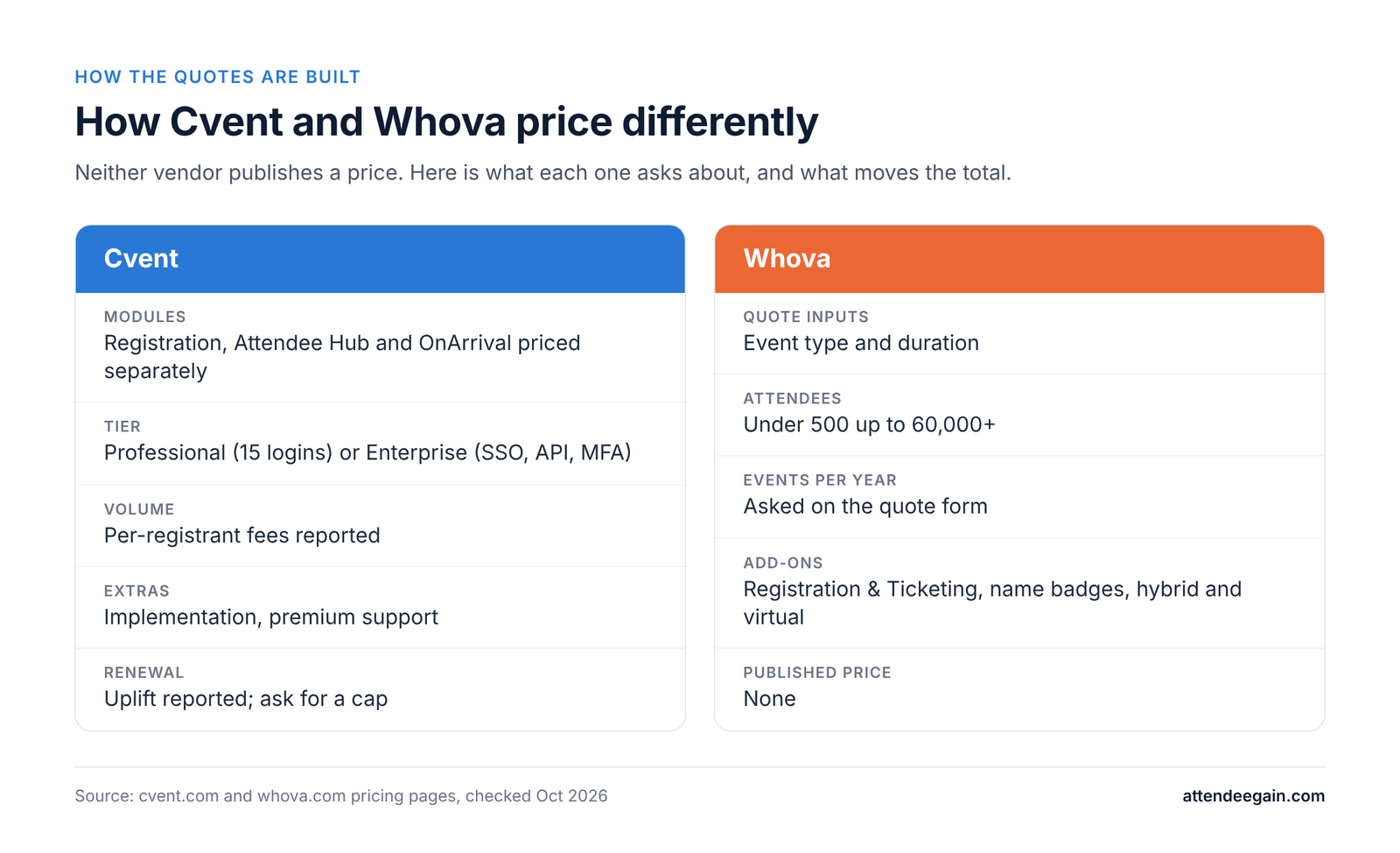
Neither vendor publishes a price. Cvent’s pricing page offers custom quotes: Registration, Attendee Hub and OnArrival are each priced on their own, a Professional tier includes 15 user logins, and an Enterprise tier adds SSO, API access, MFA and budget management. Whova’s pricing page is a quote form that asks for event type, duration, expected attendees (from under 500 to over 60,000) and events per year.
What third parties report, treated as estimates:
| Cvent | Whova | |
|---|---|---|
| Reported annual cost | About $19,600 to $79,000+ a year (Rework); a median near $19,550 (Nunify) | Often quoted per event; one roundup lists $1,499 for up to 500 attendees over two days up to $5,999 (Fliplet) |
| Per-attendee or per-ticket charges | Per-registrant fees on top of the license, reported | Reported processing fee on paid tickets of about 3.0% + $0.99 (Nunify) |
| Extras that move the total | Attendee Hub, OnArrival, implementation, premium support, renewal uplift | Registration & Ticketing, name badges, hybrid and virtual |
Treat these as ranges to test, not facts. All three sources sell competing products, and the Whova figures from different sources do not agree with each other.
How to compare them fairly
- Fix the scenario. Example: one 800-person, two-day conference with paid registration, onsite badge printing and a mobile app, run once a year. Then a second scenario: six events across the year, 300 to 2,000 attendees each.
- Ask both vendors for a written quote for both scenarios, with every line itemized.
- Add what quotes leave out: implementation or build services, badge hardware and paper, payment processing, and your team’s hours.
- Ask each for renewal terms. For Cvent, ask for the per-registration rate, overage terms and renewal escalation percentage in writing. For Whova, ask whether the event price holds if attendance grows.
One rule of thumb: Whova’s per-event model tends to look cheaper for one or two events a year. Cvent’s license model tends to look better once you run many events and the fixed cost spreads. Check it against your own numbers before you believe it.
Implementation, support, security and AI
Implementation. Cvent setups usually need a trained admin or an implementation partner, because registration rules, approvals, integrations and the app all have to be configured and tested together. Whova is lighter to configure, and many conference teams self-serve with a demo and onboarding support. Whichever you pick, budget time for data import, branded pages, payment testing and a dress rehearsal of check-in.
Support. Cvent lists a client services team of 1,800+ people and tiered support; ask which tier your contract includes and what response times apply during your event week. Whova offers a demo and onboarding; ask what live support looks like onsite.
Security. Ask both for their current SOC 2 report or equivalent, data-residency options, SSO and MFA availability, and how attendee data is deleted after the event. On Cvent, SSO, API access and MFA sit in the Enterprise tier. We could not verify Whova’s certifications from its public pages, so request them in writing.
AI. Cvent advertises AI-driven agenda building in Attendee Hub. For any AI feature, ask what data it uses, whether it can be turned off, and whether it is included in the license or charged separately.
Switching. Moving from Whova to Cvent, or the reverse, means exporting attendees, sessions, speakers and registration answers, then rebuilding forms, emails and the app. Start months before your contract ends, and migrate events that are open for registration first.
Which should you choose?
- Pick Cvent if you run many events a year, need approvals, multi-stakeholder governance, cross-event reporting or SSO and API access, and have an admin or partner to run it.
- Pick Whova if you run a small number of conferences, association meetings or academic events, attendee engagement matters most, and you want a faster, lighter setup.
- Run both side by side only if you have a clear split, for example Cvent for flagship events and Whova for community meetups. Two systems mean two data sets to reconcile.
FAQ
Is Whova cheaper than Cvent? For one or two events a year it often is, but neither vendor publishes prices, so get itemized quotes for the same scenario.
Does Whova publish its pricing? No. Its pricing page is a quote request based on event type, duration, attendee count and events per year.
Does Cvent have a mobile event app? Yes. Attendee Hub covers the mobile app, networking, chat, polling and live or on-demand video, and is licensed separately from Registration.
Which is better for networking? Whova is widely rated as strong for attendee networking. Cvent’s Attendee Hub also includes networking, so test both with your own agenda and audience.
Which is easier to implement? Whova is generally lighter. Cvent takes longer to configure but covers more.
Can I switch from one to the other? Yes. Export attendees, sessions and speakers, then rebuild forms and the app. Start months before your contract ends.
Need help choosing or setting up?
AttendeeGain implements Cvent and works with Whova, Bizzabo, Swoogo and Splash. Tell us your event size and volume and we will tell you which platform fits and what it will take to run it. See our Cvent expertise and Whova expertise, or contact us. For onsite check-in and badging, see onsite solutions.
Sources: Cvent pricing, Whova pricing.