Quick Answer
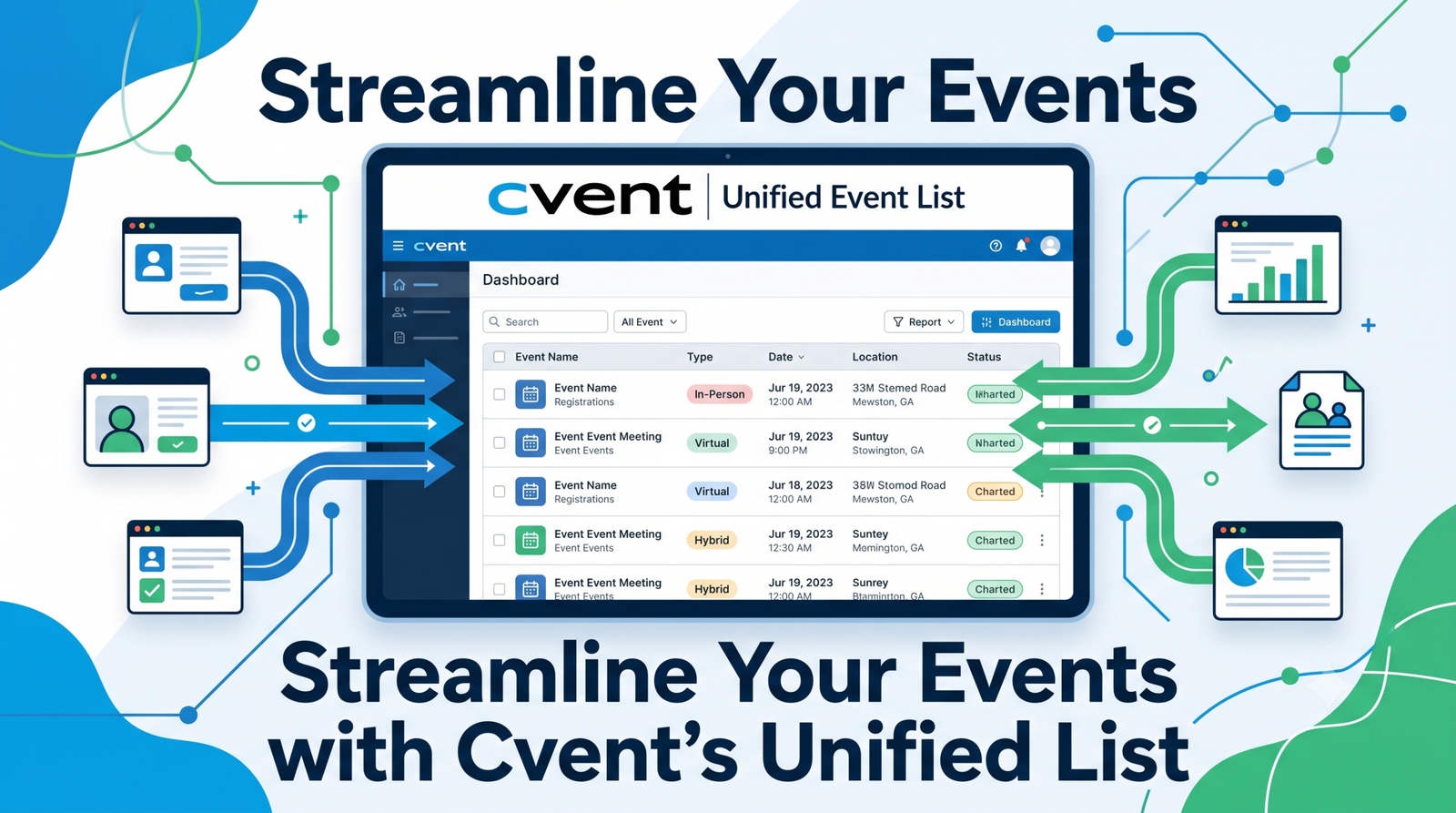
The Cvent Unified Event List is a redesigned interface, expected in Q3 2026, that brings every event type — conferences, webinars, roadshows, trainings, and field events — into a single event record. Venue sourcing, room blocks, scheduling, and registration data all live inside that one record, instead of scattered across separate tools. It’s not live yet, but the logic behind it matters now: if your organization runs different event formats through different systems, this is the change to plan around.
Key Takeaways
- Cvent’s Unified Event List brings conferences, webinars, roadshows, trainings, and field events into one record.
- It’s expected in Q3 2026. No public beta exists yet as of this writing.
- It’s the direct product answer to Cvent’s own consolidation strategy — acquiring Goldcast and ON24, then folding webinars into the same platform as flagship conferences.
- The real cost it targets isn’t software spend. It’s duplicate data entry, fragmented registration reporting, and no single view of an attendee across event types.
- We built a consolidation-readiness checklist below so you can start preparing before the feature ships.
Why This Exists: The Problem It's Solving
Most organizations don’t run one kind of event. They run flagship conferences, recurring webinars, regional roadshows, and trade-show activations — often through different tools, bought at different times, by different teams.
Cvent’s own product leadership has acknowledged this directly. The company has said internally that it never wanted a single real-world event to exist as ten different records across ten different systems — but its own growth through acquisition created exactly that problem. The Unified Event List is the fix: one record per event, regardless of format, with sourcing, room blocks, scheduling, and registration all attached to it.
Before and After: What Actually Changes
Here’s the practical difference, dimension by dimension.
| Dimension | Before (siloed tools) | After (Unified Event List) |
|---|---|---|
| Where an event lives | Conferences in Event Management, webinars in a separate platform, roadshows in Essentials, trade shows in a lead-capture tool | One event record, regardless of format |
| Venue sourcing | Tracked separately per event type, if tracked at all | Accessible from inside the event record |
| Room blocks | Managed in Passkey, disconnected from the marketing side | Same record, same navigation |
| Registration data | Split across platforms, no single funnel view | Unified registration data per event |
| Reporting | Manual exports stitched together by hand | One record to report from |
| Where planners work | Multiple logins, multiple tabs, constant context-switching | One navigation, every event type |
The pattern across every row is the same: fewer systems holding pieces of the same truth, and less manual reconciliation to get a straight answer.
The Hidden Cost of Running Siloed Event Tools
Most teams underestimate what fragmentation actually costs, because it doesn’t show up as a single line item. It shows up as:
- Duplicate data entry. The same event gets built twice — once in the conference platform, once in the webinar tool — because nothing talks to the other.
- No cross-event attendee view. Features like Global Profiles depend on unified data. If your webinar attendees and conference attendees live in separate systems, you can’t build the cross-event picture that makes personalization actually work.
- Reporting overhead that eats real hours. Producing one number — total program reach, cost per lead, pipeline influenced — means manually combining exports from multiple tools every time someone asks.
- Redundant licensing. Paying for overlapping capabilities across two or three platforms adds up quietly, especially once Cvent’s own webinar tools (via Goldcast and ON24) already cover ground a standalone tool used to own alone.
None of these costs are dramatic on their own. Together, they’re usually bigger than the price of the consolidation project people avoid starting.
Consolidation-Readiness Checklist
Use this to find out how exposed your organization is before the Unified Event List ships — and to get ahead of the migration once it does.
- Inventory every tool currently running events. List your webinar platform, field-event tool, trade-show lead-capture system, and conference platform by name.
- Map ownership. Identify which team owns each tool, and flag anywhere ownership overlaps or nobody’s clearly in charge.
- Find your duplicate-entry points. Identify events that already get built more than once across systems today — that’s your direct cost of fragmentation.
- Check contract renewal dates. If a standalone webinar or field-event tool renews soon, weigh that against Cvent’s own Goldcast/ON24-powered capabilities before signing again.
- Audit registration reporting. Try to produce one report across all your event formats today. If you can’t do it without manual work, that’s the gap consolidation closes.
- Flag heavily customized event types. Anything with deep, tool-specific customization will likely need the most planning before it can move.
What to Do Now, Before It Ships
The Unified Event List isn’t live yet, so there’s nothing to configure today. But the checklist above is real work you can start now — inventorying your stack, mapping ownership, and auditing your reporting gaps doesn’t require Cvent to ship anything first. Organizations that do this groundwork early will move through the actual migration far faster than those who wait for the feature and then start from zero.
For a full walkthrough of migrating onto a consolidated Cvent stack, see our Cvent implementation checklist. For everything else Cvent announced alongside this feature, check the CONNECT 2026 roadmap hub.
FAQs
What is the Cvent Unified Event List? The Unified Event List is a redesigned Cvent interface that brings every event type — conferences, webinars, roadshows, trainings, and field events — into a single event record, with venue sourcing, room blocks, scheduling, and registration data all attached to that one record.
When is the Unified Event List launching? Cvent expects to ship it in Q3 2026. No public beta program exists yet as of this writing.
Why did Cvent build the Unified Event List? To solve a problem created largely by its own growth through acquisition: the same real-world event ending up represented as multiple separate records across different systems, including the webinar platforms Cvent acquired through Goldcast and ON24.
How do I prepare my organization for the Unified Event List? Inventory every tool currently running your events, map which team owns each one, identify where the same event gets entered more than once, and audit whether you can currently produce one report across all event formats. Our consolidation-readiness checklist above walks through each step.
Does the Unified Event List replace Cvent’s other products? No. It’s a navigation and data layer that unifies how existing event types — conferences, webinars, roadshows, field events — get organized and accessed, not a replacement for the underlying tools that run each format.