Nitish Verma

Hubilo Setup Guide: Getting the Most from Your Event Platform

Hubilo has rapidly evolved into one of the most engaging and robust event platforms available for virtual, hybrid, and in-person experiences. Known for its hyper-focus on attendee engagement and intuitive interface, it offers event organizers a powerful toolkit to drive connections and deliver top-tier content.

However, a platform is only as effective as its configuration. A hasty or incomplete setup can lead to broken registration links, confusing navigation, and missed engagement opportunities. To truly leverage the platform’s capabilities, you need a strategic approach to building your event environment.

Whether you are configuring a massive global summit or a specialized corporate workshop, this definitive Hubilo setup guide will walk you through the critical phases of platform configuration to ensure your next event is a resounding success.
Phase 1: Laying the Foundation (Branding & Basics)

Before adding speakers or building agendas, you must establish the core identity of your event within Hubilo. Consistency here builds trust and excitement among your registrants.

  • Event Details & Custom Domains: Start by entering your fundamental event data (date, time zone, event type). For a truly white-labeled experience, configure a custom domain (e.g., events.yourcompany.com). This requires updating your DNS records but is crucial for enterprise brand authority.

  • Branding and UI Customization: Hubilo allows for extensive visual customization. Upload your logos, define your primary and secondary brand colors, and select customized banners for the login screen and reception area.

  • The Reception Area: Think of the Reception page as your virtual lobby. A top-tier setup utilizes welcome videos, clear navigation banners, and highlighted sponsor logos to immediately orient attendees as soon as they log in.

Phase 2: Building the Architecture (Registration & Ticketing)

A flawless registration process is your first impression. If it’s clunky, you will lose attendees before the event even begins.

  • Ticket Tiers & Access Controls: Define your ticket categories (e.g., General Admission, VIP, Exhibitor). Hubilo allows you to gate specific content based on ticket types. For example, you can restrict access to an exclusive networking lounge so only VIP ticket holders can enter.

  • Custom Registration Forms: Don’t just ask for a name and email. Use custom fields to gather valuable attendee data—such as job titles, industry interests, or dietary restrictions (for hybrid/in-person). This data is critical for Hubilo’s AI matchmaking features later on.
Phase 3: Crafting the Experience (Agendas, Speakers, & Sponsors)

Content is the heart of your event, and how you organize it dictates the attendee experience.

  • Multi-Track Agendas: If you have concurrent sessions, build a multi-track agenda. Color-code different tracks (e.g., Marketing, Sales, Product) so attendees can easily filter the schedule and build their own personalized itineraries.

  • Speaker Profiles: Rich speaker profiles drive session attendance. Ensure every speaker has a high-resolution headshot, a compelling bio, and links to their LinkedIn profiles. Link speakers directly to their respective sessions so attendees can easily navigate between the two.

  • Sponsor & Exhibitor Booths: Hubilo excels at sponsor ROI. Set up virtual booths with tiered sizes (Large, Medium, Small) based on sponsorship packages. Enable features like document drops, promo videos, and the “Drop a Business Card” function to maximize lead generation for your partners.

Phase 4: Maximizing Engagement (Networking & Gamification)

Hubilo’s biggest differentiator is its engagement suite. A standard setup ignores these tools; a Rank-1 setup makes them the centerpiece.

  • AI Matchmaking & Lounges: Enable the AI matchmaking feature to suggest connections to attendees based on the data they provided during registration. Set up virtual networking lounges with specific topics to facilitate organic, unforced conversations.

  • Contests and Leaderboards: Gamification is a proven strategy to keep attendees clicking, watching, and interacting. Assign point values to desired actions: attending a keynote (50 points), visiting a sponsor booth (20 points), or asking a question in the Q&A (10 points). Display a live leaderboard to spark friendly competition.

Phase 5: The Technical Backbone (Integrations & Dry Runs)

Your event does not exist in a vacuum; it needs to communicate with your existing tech stack.

  • CRM & Marketing Integrations: Connect Hubilo to tools like HubSpot, Salesforce, or Marketo. Ensure that when someone registers, they are automatically tagged in your CRM, and that post-event engagement data (like sessions watched) flows back to your sales team seamlessly.

  • The Dry Run: Never go live without a dress rehearsal. Run a complete test with your team acting as attendees, speakers, and sponsors. Test the live stream latency, check the sponsor booth downloads, and ensure the gamification points are calculating correctly.
When to Bring in a Hubilo Expert

Following a Hubilo setup guide is highly effective for straightforward events. However, as your event scale and complexity increase, the risk of technical oversight grows.

You should consider partnering with a certified Hubilo expert or managed service agency if:

  1. You are short on time: Your internal team needs to focus on content and marketing, not software configuration.

  2. Complex Integrations are required: You need custom API setups to sync advanced data across multiple enterprise systems.

  3. High-Stakes Execution: It is a flagship event, and you need a dedicated technical support team monitoring the live stream, managing speaker transitions, and providing real-time attendee troubleshooting.

An expert agency transforms the platform from a simple venue into a high-converting, lead-generating machine.

Conclusion

Setting up Hubilo requires more than just filling out text boxes; it requires a strategic understanding of attendee behavior, sponsor needs, and data flow. By following this guide, you can lay a robust foundation for an engaging and profitable event. Take your time, test everything, and when the complexity scales beyond your bandwidth, don’t hesitate to bring in an expert to guarantee a flawless execution.

Picture of Abhishek Kapoor

Abhishek Kapoor

Abhishek Kapoor is the founder and creative head of BrandWorks Worldwide. His is an ex-Cvent and has worked in the event space for the last 13 years, providing branding and registration expertise to many clients globally.

Hubilo Setup Guide: Getting the Most from Your Event Platform Read More »
Bizzabo Managed Services: How Expert Support Transforms Your Events

If you are running enterprise-level events, you already know that Bizzabo is one of the most powerful Event Experience Operating Systems (OS) on the market. From seamless registration flows to dynamic wearable technology (SmartBadgesâ„¢) and robust data analytics, it has everything you need.

However, having access to a world-class tool and extracting its maximum value are two different things.

Running a complex hybrid or in-person event requires meticulous planning, precise technical execution, and constant monitoring. This is exactly where Bizzabo managed services step in. By partnering with a dedicated Bizzabo expert agency, event marketers and organizers can bridge the gap between software capabilities and flawless event execution.

In this guide, we will explore how utilizing expert support for your Bizzabo platform can transform your event strategy, reduce your team’s stress, and ultimately drive a higher return on investment (ROI).

What Are Bizzabo Managed Services?

Bizzabo managed services refer to professional, end-to-end support provided by certified platform experts who handle the technical setup, customization, and ongoing management of your Bizzabo environment.

Rather than forcing your internal marketing or IT teams to learn the intricacies of a complex event platform, an expert agency takes the wheel. These services typically cover:

  • Pre-Event Setup: Building custom registration pages, designing the event website, and configuring ticketing tiers.

  • Integrations & Automation: Syncing Bizzabo with your CRM (like Salesforce or HubSpot) and marketing automation tools.

  • Onsite & Virtual Technical Support: Managing live streams, configuring the mobile app, and overseeing onsite check-in hardware.

  • Post-Event Reporting: Extracting actionable insights from attendee data to measure success.

Why Partner with a Bizzabo Expert Agency?

When you hire a specialized Bizzabo expert agency, you aren’t just outsourcing a task; you are integrating a team of event technologists into your strategy. Here is why top-tier enterprise teams are making this shift.


1. Accelerated Setup and Flawless Execution

The learning curve for enterprise event software can be steep. A single misconfigured setting in your registration flow or a broken API link to your CRM can result in lost leads and frustrated attendees.

Bizzabo experts live and breathe the platform. They utilize best practices and proven templates to rapidly deploy your event architecture. This ensures zero downtime, eliminates bugs before launch, and guarantees that your attendees experience a frictionless journey from the moment they click “Register.”

2. Deep Customization That Aligns With Your Brand

Standard templates are great, but enterprise events demand bespoke branding. A Bizzabo expert agency possesses the technical coding skills (HTML/CSS) to push the platform’s design capabilities to their limits.

They can create immersive, fully branded event websites and customize the Bizzabo mobile app to ensure it feels like a seamless extension of your company’s digital presence.

3. Maximizing the Value of Hybrid Experiences

Hybrid events are notoriously difficult to manage because you are essentially running two events simultaneously: one in the room and one online.

Expert support teams manage the complex digital logistics. They ensure the Bizzabo virtual venue is perfectly synced with the physical event, manage video-on-demand (VOD) assets, monitor live stream latency, and ensure virtual attendees have engaging networking opportunities through the platform’s matchmaking features.

4. Unlocking Advanced Data and Analytics

Data is the ultimate currency of event marketing. Bizzabo captures thousands of data points—from session attendance duration to poll engagement and networking interactions.

However, raw data is useless without interpretation. A Bizzabo expert agency will configure custom dashboards, set up proper UTM tracking, and build cross-platform integrations to ensure event data flows seamlessly into your sales pipeline. This allows you to prove the exact ROI of your event to stakeholders.

Core Phases Managed by Your Support Team

To understand the full impact, let’s break down how Bizzabo managed services support the three critical phases of an event lifecycle.


Pre-Event: The Foundation

  • Platform Architecture: Structuring multi-track agendas and complex speaker profiles.

  • Marketing Operations: Setting up automated email cadences for registrants, waitlists, and incomplete checkouts.

  • Integration Testing: Running rigorous QA (Quality Assurance) tests on payment gateways and CRM data flows.

During the Event: The Command Center

  • Onsite Check-in Management: Setting up Bizzabo’s onsite solutions, including kiosk design and badge printing workflows.

  • Live Troubleshooting: Providing real-time support for attendees navigating the mobile app or virtual venue.

  • Speaker & Sponsor Management: Ensuring sponsors get their promised digital real estate and speakers have seamless technical transitions.

Post-Event: The Wrap-Up

  • Content Repurposing: Transitioning live sessions into gated, on-demand content within the Bizzabo ecosystem.

  • Lead Handoff: Ensuring all qualified leads are scored and passed to the sales team without manual data entry.

  • Debrief & Strategy: Reviewing platform analytics to identify what worked, what didn’t, and how to optimize the next event.

Is Hiring a Bizzabo Expert Agency Right for You?

You should seriously consider investing in managed services if:

  1. Your internal team is stretched thin and lacks dedicated event technologists.

  2. You are hosting high-stakes events (user conferences, massive trade shows, global summits) where failure is not an option.

  3. You want to move beyond basic registration and utilize Bizzabo’s advanced features, like the SmartBadgeâ„¢ wearable tech or intricate CRM integrations.

  4. You struggle to prove the direct ROI of your event marketing spend.

Conclusion: Focus on Strategy, Delegate the Software

Your event marketing team’s primary goal should be crafting compelling content, securing top-tier speakers, and engaging with attendees. They shouldn’t be bogged down in software configurations, API troubleshooting, or HTML coding.

By utilizing Bizzabo managed services, you empower your team to focus on the big picture. A dedicated Bizzabo expert agency handles the heavy technical lifting, transforming a powerful software platform into a flawlessly executed event experience. Invest in the right support, and watch your event ROI—and attendee satisfaction—soar.

Picture of Abhishek Kapoor

Abhishek Kapoor

Abhishek Kapoor is the founder and creative head of BrandWorks Worldwide. His is an ex-Cvent and has worked in the event space for the last 13 years, providing branding and registration expertise to many clients globally.

Bizzabo Managed Services: How Expert Support Transforms Your Events Read More »
How AI Is Changing Corporate Event Planning in 2026 (Opinion)

The Hype is Over: The era of Pragmatic Intelligence Has Begun

Ten years ago, AI in event planning was limited to basic chatbots and superficial text generation. If you are managing events for a global enterprise in 2026, you know that era is dead.

We are no longer discussing if we should use AI; we are discussing how we should govern, deploy, and master AI event planning to drive definitive global pipeline and operational precision.

This is an opinion piece on the radical transformation we are seeing inside the software every single day. At AttendeeGain, we bridge the gap between event logistics and deep software architecture, and the consensus is clear: In 2026, the definition of a “world-class event planner” is a “world-class event technologist” who knows how to collaborate with AI.

The Shift from Manual Execution to Strategic Engineering

AI has ceased being an external tool and has become integrated intelligence. It has transformed from a “writer” (text generation) into an “architect” (predictive logic).

Redefining the Pre-Event Pipeline

The legacy approach was manual research and generic RFPs. In 2026, the AI engine is deployed at the Strategic Meetings Management (SMM) level.

  • Predictive Sourcing (SMM AI): When a global procurement director submits an MRF via Cvent in 2026, AI audits historical spend data, 2026 localized pricing indices, and current legal compliance frameworks to predict the cost-per-attendee (CPA) and ROI of that meeting before the planner can select a venue.

  • Dynamic Registration Fields: The form is no longer static. When an attendee from a target ABM account registers, Cvent’s AI reads their intent signals (e.g., they just viewed the product roadmap page) and dynamically updates the form to offer them personalized session tracks focused on product innovation, bypassing generic general admission paths.

Redefining the Live Onsite Experience

Manual session tracking is obsolete. AI has made data capture and interaction immediate.

  • Passive Engagement Scoring: AI in 2026 isn’t just counting heads. By auditing RFID dwell time and digital Attendee Hub interactions (polling, live Q&A), AI generates real-time “Account Sentiment Scores,” alerting a sales rep that a specific prospect is showing high intent during the keynote.

  • The Universal Translator: The complex global event in 2026 relies on AI for inclusive accessibility. In the Cvent Attendee Hub, virtual attendees can view keynotes with real-time, zero-latency captioning translated into any of 200+ global languages, while physical attendees can use AR interfaces to translate physical booth signs and maps.

The Post-Event AI Verdict: Proving Definitive ROI

This is where AI has completely redefined the boardroom conversation. The transition from attribution to definitive value is now an automated technical workflow.

  • Closed-Loop Salesforce Attribution: Do not download spreadsheets. You must programmatic integrate Cvent with Salesforce Campaigns. Six months later, when a Sales Rep closes a $100k deal, the Salesforce dashboard will automatically attribute a portion of that revenue to the specific Cvent event that prospect attended.

  • Operational Profitability: By leveraging audited historical data from previous events (audited through Cvent’s relational database), AI will automate venue spend optimization, reducing the overall portfolio cost-per-attendee (CPA) by an audited average of 15% through optimized concessions and unified global contracting.

Conclusion: The "Human-in-the-Loop" Mandate

My opinion is not that AI will replace event planners. The mandate for 2026 is The Human-in-the-Loop.

AI is unmatched at processing massive data, predicting costs, and automating workflows. It is abysmal at understanding strategic context, managing white-glove VIP dynamics, and resolving the complex onsite glitches that can derail a global user conference.

The value of AttendeeGain in 2026 is that we are the technical bridge.

We don’t just use AI; we architect the integrated data ecosystems that make it powerful. Whether you need sophisticated custom API CRM integrations using modern tech stacks (Next.js frontends or headless CMS architecture), multi-tiered SMM workflows with AI logic, or flawless onsite OnArrival networks, our technologists build the foundation for your strategic human intuition.

Stop fighting the AI hype and start architecting the future of intelligence. Contact AttendeeGain today to have a certified expert audit your corporate AI and event tech strategy.

Picture of Abhishek Kapoor

Abhishek Kapoor

Abhishek Kapoor is the founder and creative head of BrandWorks Worldwide. His is an ex-Cvent and has worked in the event space for the last 13 years, providing branding and registration expertise to many clients globally.

How AI Is Changing Corporate Event Planning in 2026 (Opinion) Read More »

Incentive Travel in 2026: Planning, Platforms & ROI Benchmarks

Beyond the Boomerang: Incentives as Strategic Performance Accelerators

In 2026, the incentive travel model has completely matured. The “legacy” approach—sending top salespeople on a luxury vacation and hoping for the best—has vanished, replaced by sophisticated, data-driven Strategic Meetings Management (SMM).

Incentives in 2026 are recognized not as transactional rewards, but as critical Strategic Business Units and performance accelerators. When globally managed (audited via Cvent), they drive definitive revenue growth, foster irreplaceable high-fidelity networking, and reinforcing organizational culture.

If you are a corporate VP of Sales, HR Director, or Procurement Head, you must adopt a 2026 strategy. In this definitive guide, AttendeeGain deconstructs the framework for planning and benchmarking profitable, impactful Incentive Travel in 2026.

1. The Evolving Philosophy of Incentives: Meaning Over Transaction

By 2026, the criteria of “high-net-worth” is changing. Your top performers don’t just want luxury; they want exclusivity, personalization, and impact.

  • Personalized Travel Journeys: Generic group itineraries are obsolete. Planners are using Cvent data to programmatic build personalized travel packages, automatically syncing flights, hotel preferences, and specific optional excursions.

  • The “Value of Time” Benchmark: A winner from the early 20s wanted “more luxury.” In 2026, they calculate the “value of their time.” Incentives must offer white-glove logistical execution (managed via Cvent OnArrival in-room check-ins) and deeply exclusive networking opportunities that cannot be duplicated.

2. The Tech Stack: Essential Platforms for 2026 Execution

Executing a world-class incentive trip requires more than spreadsheets and a generic travel agency. It requires integrated enterprise technology.

  • Cvent SMM Portals: Incentives are integrated into the global meeting portfolio. Planners submit Meeting Request Forms (MRFs) through Cvent, automatically triggers budget and compliance workflows, reducing attrition and maximizing buying power.

  • The Cvent Supplier Network (CSN): Sourcing venues in 2026 relies on data precision. Planners don’t just “filter for luxury”; they filter RFPs based on the venue’s audited 2026 sustainability scores and duty-of-care protocols.

3. The Definitive ROI Benchmarks: What Your CFO Must See

Incentives in 2026 do not exist without financial validation. CFOs expect:

  1. Revenue Growth Attribution (Pipeline Closed): Compare the sales data of “Winners” vs. “Non-Winners.” Organizations leveraging Cvent’s native integration or custom REST APIs to map trip costs against sales pipeline closed have recorded definitive proof that incentive winners close 3x more deals compared to non-winners.

  2. Audited SMM Cost Savings: Use historical data Audited from previous Cvent CSN RFPs to prove how the formalized SMM program reduced cost-per-attendee (CPA) by an audited average of 15% through optimized concessions and unified global contracting.

  3. Duty of Care Validation: Global Duty of Care is a legal mandate. Your 2026 report must prove that 100% of the attendees are tracked globally via Cvent OnArrival and emergency communications protocols.

Conclusion: Infrastructure Dictates Outcome

The incentive travel philosophy of 2026 is simple: Strategy requires precise technical architecture. You cannot execute a personalized, impactful reward while fighting fragmented, siloed data.

At AttendeeGain, we act as your elite event technology architects. We don’t just know incentives; we know the deep technical architecture required to execute them flawlessly and measure their value to the board. Whether you are building complex global SMM workflows, deploying immersive onsite OnArrival networks that feed pristine intent data into Cvent, or integrating complex Salesforce REST APIs to prove definitive sales pipeline closed, our technologists build the foundation for your success.

Stop risking your incentive spend. Ensure definitive motivation and verifiable ROI. Contact AttendeeGain today for a comprehensive audit of your global corporate incentive travel strategy.

Picture of Abhishek Kapoor

Abhishek Kapoor

Abhishek Kapoor is the founder and creative head of BrandWorks Worldwide. His is an ex-Cvent and has worked in the event space for the last 13 years, providing branding and registration expertise to many clients globally.

Incentive Travel in 2026: Planning, Platforms & ROI Benchmarks Read More »

Corporate Event ROI: How to Prove Value to Your CFO

The End of Vanity Metrics in 2026

Ten years ago, event success was measured by empty buffet trays, post-event survey “smiles,” and total registration counts. In 2026, in a volatile global economy, that is no longer acceptable.

When a global enterprise spends $500,000 on an annual user conference or a series of global ROADSHOWS, the executive board expects hard data. They want to know the definitive Cost Per Acquisition (CPA), the pipeline revenue influenced, and the tangible engagement of target accounts.

The event portfolio has matured into a critical Strategic Business Unit (SMM) and revenue operator. If you want to secure your event budget for next year, you must master the technical architecture to measure, report, and validate definitive Corporate Event ROI.

Here is the data-driven framework to prove event value to your CFO in 2026.

1. The Transition from Transactional Metrics to Strategic Value

Your CFO does not care about “engagement rate” if it doesn’t close deals. In 2026, the definition of Event ROI has been refined into two definitive outcomes: Revenue Generation and Operational Efficiency.

Vanity Metrics (Legacy)

  • Registration Counts

  • Post-Event Surveys

  • Total Attendees

Strategic Metrics (2026 Standard)

  • Definitive CPA & CPL

  • Closed-Loop Salesforce Attribution

  • Engagement Score Impact on Deal Velocity

  • Programmatic Cost Savings (SMM)

2. A 4-Step Technical Framework for Measuring True ROI

Measuring definitive event value is not about post-event surveys; it is about pre-event data architecture.

Step 1: Architect the Data Blueprint (Registration Logic)

True ROI begins at registration. You must map your data. By defining custom “Contact Fields” in Cvent and aligning them perfectly with your Salesforce fields, you ensure data integrity from the very first click.

Step 2: Track Passive Intention Signals (Onsite Dynamics)

Post-event surveys are subjective. Passive data is objective. By deploying RFID session tracking or digital check-ins, you capture hard behavioral data: who attended which product roadmap session and exactly how long they stayed (Dwell Time).

Step 3: Unify the Hybrid Audience (Engage and Automate)

In 2026, the hybrid structure must unify Live Q&A and polling within the Cvent Attendee Hub. This creates a powerful data pool. Virtual attendee interactions are intend signals just like physical attendee badge scans. Push theseEngagement Scores instantly to the CRM.

Step 4: Automate Salesforce Attribution (The Closed-Loop)

This is the holy grail. Do not download spreadsheets. You must programmatic integrate Cvent with Salesforce Campaigns.

  • The ROI: Six months later, when a Sales Rep closes a $100k deal, the Salesforce dashboard will programmatic attribute a portion of that revenue to the specific Cvent event that prospect attended.

3. The 2026 Executive ROI Report: What Your CFO Must See

When you step into the boardroom, do not show a generic summary. Show definitive business outcomes.

  • Cost-Per-Acquisition (CPA): Prove how event-based lead generation compares to your paid search or social spend. The logic will likely show events are a more cost-effective CPL driver for high-intent B2B accounts.

  • Pipeline Acceleration Velocity: Compare the “Close Date” of a deal for attendees vs. non-attendees. If a prospect attended a Cvent event, did the deal close 30% faster?

  • Audited Cost Savings (The SMM Angle): Use historical data from the Cvent Supplier Network (CSN) to prove how the Strategic Meetings Management program optimized venue spend, reducing cost-per-attendee (CPA) by an audited average of 15%.

Conclusion: Stop Speculating, Start Architecting

In 2026, Corporate Event ROI is not a guess; it is a verifiable financial outcome driven by sophisticated technical architecture. If your event tech is siloed or your API integrations are siloed, your data is compromised and your ROI story is fundamentally flawed.

That is exactly why AttendeeGain exists.

We do not just known events; we known the deep technical architecture required to measure their impact. Whether you need to automate your global SMM workflows, deploy immersive onsite OnArrival networks that feed pristine intent data into Cvent, or integrate complex Salesforce REST APIs to prove definitive pipeline acceleration, our technologists ensure every dollar of your event spend is tracked, measured, and validated in the boardroom.

Ready to maximize your Cvent investment and prove event value to your board? Don’t let broken data compromise your 2026 success. Contact AttendeeGain today for a comprehensive audit of your corporate event data architecture.

Picture of Abhishek Kapoor

Abhishek Kapoor

Abhishek Kapoor is the founder and creative head of BrandWorks Worldwide. His is an ex-Cvent and has worked in the event space for the last 13 years, providing branding and registration expertise to many clients globally.

Corporate Event ROI: How to Prove Value to Your CFO Read More »

How to Build a Corporate Event Tech Stack for 2026

The Fragmented Tech Trap of 2026

If you are managing events for a global enterprise in 2026, you are likely suffering from the “Fragmented Tech Trap.” You have one tool for registration, another for live streaming, a third for onsite check-in, and a fourth trying to push generic data into Salesforce via a fragile Zapier integration.

The result is operational chaos: duplicate records in your CRM, data silos that mask true ROI, and a frustrating, fragmented attendee experience.

Your event technology is no longer a collection of apps; it is critical corporate RevOps infrastructure. To drive definitive revenue and operational efficiency in 2026, you must abandon fragmented tools and architect a unified, scalable ecosystem.

Here is the ultimate guide to building a future-proof, high-performing corporate event tech stack in 2026.

1. Defining the Core Categories of the 2026 Tech Stack

Before selecting tools, you must define the foundational modules of your event technology architecture.

The Foundation: The Centralized Ecosystem (The "One Platform" Rule)

In 2026, the era of “best-of-breed” fragmented stacks is dead. The standard is a unified platform (like Cvent) that owns the entire stack.

  • Why it matters: Centralizing within Cvent ensures absolute data cleanliness. Registration data pushes instantly to the mobile app, and badging data flows seamlessly from onsite check-in back to the CRM. This eliminates duplicates and broken data mappings.

The Audience Engagement Hub

This is the digital home for both physical and virtual attendees.

  • Requirement: In 2026, the Hub (e.g., Cvent Attendee Hub) must unify Live Q&A, Polling, structured networking, and HD live streaming into a single, low-latency interface.

The Onsite Execution & Logistics Engine

When 5,000 attendees arrive on Tuesday morning, the tech cannot fail.

  • Requirement: Flawless onsite deployment of badge printing (e.g., Cvent OnArrival), RFID session tracking, and lead capture technology that syncs instantly to the CRM.

The Data & Analytics RevOps Engine

Your tech must track intention signals, not just registration counts.

  • Requirement: Native, deep integrations that map Cvent Engagement Scores directly to Salesforce Campaigns and contact records.

2. A Proven 6-Step Framework for Building a High-Converting Stack

A world-class tech stack is not built by chance; it is architected with operational precision.

Step 1: Identify Business Goals (The "Why")

Are your 2026 events primarily for global ABM pipeline, internal culture, or professional education? Your stack must reflect the primary revenue or operational metric you must deliver.

Step 2: Audit and Map Data Flows

Never choose a tool without mapping the data. Where does a registration click live? Where does a badge scan end up? Map every field mapping between Cvent and Salesforce before signing a license.

Step 3: Implement the "One Platform" Model (e.g., Cvent)

Transition your event portfolio into a centralized enterprise ecosystem (like Cvent). This instantly consolidates SMM workflows, standardizes legal compliance, and ensures data integrity.

Step 4: Integrate and Automate Lead Flow

Do not download spreadsheets. Deeply integrate Cvent via REST APIs or native connectors with your corporate CRM (Salesforce/HubSpot) and Marketing Automation platform (Marketo). Automate lead scoring based on Engagement Scores and session dwell time.

Step 5: Analyze Real-Time Intent Signals

Move beyond post-event surveys. Monitor Cvent dashboards during the event to track which sessions have the highest engagement and which sponsored networking hours are driving the most 1-on-1 meetings.

Step 6: Optimize Portfolio Architecture Year-Over-Year

Event tech in 2026 is an iterative engine. Use historical data audited from previous events to optimize venue concessions (via CSN) and content strategy for next year.

Case Study: Architecture Wins the Deal

A global SaaS enterprise integrated Cvent with Salesforce to manage their hybrid user conference. By deploying Cvent LeadCapture to sponsors and syncing badging data instantly to Salesforce, they recorded a 4x increase in conversion rate from “Qualified Lead” to “Pipeline Influenced,” proving definitive ROI to their board.

Conclusion: Infrastructure is Destiny

Building a high-performing corporate event tech stack in 2026 is not a marketing project; it is a complex software architecture, data routing, and financial integration challenge. If you are trying to piece together fragmented apps, you are building an operation on quicksand.

Why take the risk?

At AttendeeGain, we don’t just know how to run events; we understand the deep technical architecture of the software. We specialize in building seamless, deeply integrated event tech stacks centered around the enterprise power of Cvent. Whether you need sophisticated custom API mappings to Salesforce, multi-tiered SMM workflows, or flawless onsite OnArrival networks, our technologists build the foundation for your success.

Stop viewing event tech as transactional. Start viewing it as strategic. Contact AttendeeGain today to discuss the technical architecture of your 2026 corporate event portfolio.

Picture of Abhishek Kapoor

Abhishek Kapoor

Abhishek Kapoor is the founder and creative head of BrandWorks Worldwide. His is an ex-Cvent and has worked in the event space for the last 13 years, providing branding and registration expertise to many clients globally.

How to Build a Corporate Event Tech Stack for 2026 Read More »

What Is a MICE Event? The Complete Industry Explainer for Brands & Corporates (2026)

Moving Beyond the Acronym: Defining the Strategic Business Unit

For over two decades, the acronym “MICE” (Meetings, Incentives, Conferences, Exhibitions) has been the central nervous system of global business interaction. Yet, outside of specialized procurement departments and marketing directors, the full strategic scope of the industry is often misunderstood.

In 2026, MICE events have transformed from transactional logistics into critical Strategic Business Units. They are the essential engines that drive global corporate pipeline, reinforce organizational culture, facilitate knowledge exchange, and launch innovations at scale.

If you are a corporate brand or enterprise in 2026, you are not just “booking hotel rooms”; you are deploying a critical revenue and operational accelerator. In this complete guide, AttendeeGain deconstructs the definitive industry explainer of what is a MICE event and how to execute it with technical precision in 2026.

1. Deconstructing the MICE Acronym: The Four Strategic Pillars

MICE is not a single tool; it is a massive portfolio of diverse corporate interactions. Let’s break down the definitions and the modern 2026 execution requirements for each.

M - Meetings: The Operational Core

  • Definition: Formal gatherings of professionals, typically internal, designed for training, strategy development, or product launches.

  • Modern Execution: In 2026, internal meetings are managed globally via Strategic Meetings Management (SMM) portals (audited through Cvent). This ensures data cleanliness, legal compliance, and unified budgeting (no “rogue spend”).

I - Incentives: The Performance Accelerator

  • Definition: Reward travel and unique experiences designed to motivate employees, channel partners, or sales teams to achieve hyper-specific performance benchmarks.

  • Modern Execution: Incentive travel in 2026 is data-driven. The Cvent platform is used not just to source the luxury resorts (via CSN), but to track the actual sales performance data of the winners, benchmarking trip investment against sales pipeline closed.

C - Conferences: The Thought Leadership Platform

  • Definition: Massive, multi-track flagship events designed for education, networking, and thought leadership. They can be external (user conferences) or internal (all-hands).

  • Modern Execution: Conferences in 2026 rely on deep, multi-tiered data capture. Cvent Attendee Hub functions as the central nervous system for both physical and virtual audiences, unifying Live Q&A and polling while pushing highly structured data into Salesforce Campaigns.


E - Exhibitions: The Immersive Marketplace

  • Definition: Immersive trade shows and marketplaces where brands showcase products and services, fostering commerce and industry connection.

  • Modern Execution: Exhibitions in 2026 are data-collection goldmines. Smart badging solutions passively track attendee dwell time and interaction, pushing qualified leads instantly into the exhibitor’s CRM.

2. Why MICE Events Matter for Corporate Strategy in 2026

The true explainer of MICE is not the acronym, but the definitive business outcome.

  1. Strategic Pipeline Velocity: MICE events (especially user conferences and exhibitions) are critical revenue operators. By deeply integrating Cvent into the Salesforce CRM, organizations can prove definitive pipeline influence, closing deals up to 4x faster compared to other marketing channels.

  2. Unified Data Architecture: When executed within an enterprise platform (like Cvent), MICE portfolios become massive data pools. Every registration click, session check-in, and survey answer is an intention signal captured in the relational database.

  3. Duty of Care & Compliance: For global corporations (especially in Pharma or FinServ), knowing who is attending what meeting, and ensuring legal compliance for all spend, is critical. MICE managed via SMM ensures absolute corporate compliance and instant global Duty of Care tracking.

Conclusion: Infrastructure Dictates Outcome

The definitive explainer of a MICE event is this: MICE is the technical infrastructure required to convert transactional interaction into strategic business intelligence.

Whether you are launching your first global user conference within the Cvent Attendee Hub, deploying flawless onsite badging via OnArrival, or automating your global SMM workflows, you do not need to fight the platform alone.

At AttendeeGain, we act as your elite event technology architects. We bridge the gap between event logistics and deep technical architecture, ensuring your entire MICE portfolio is profitable, compliant, and data-rich.

Stop viewing events as transactional and start viewing them as strategic. Contact AttendeeGain today to have a certified expert audit your corporate MICE portfolio.

Picture of Abhishek Kapoor

Abhishek Kapoor

Abhishek Kapoor is the founder and creative head of BrandWorks Worldwide. His is an ex-Cvent and has worked in the event space for the last 13 years, providing branding and registration expertise to many clients globally.

What Is a MICE Event? The Complete Industry Explainer for Brands & Corporates (2026) Read More »

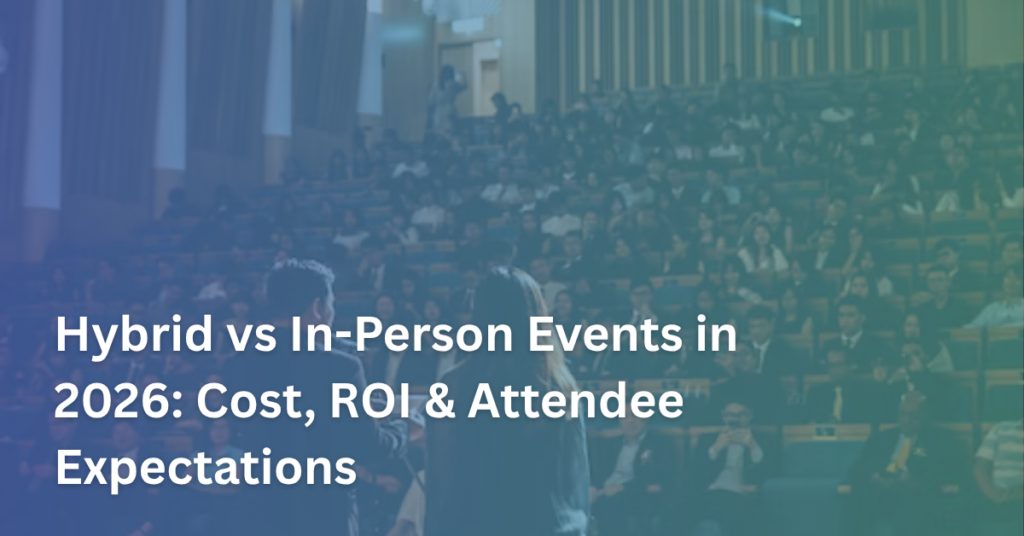
Hybrid vs In-Person Events in 2026: Cost, ROI & Attendee Expectations

The Perpetual Debate in 2026

The debate of the early 2020s has finally settled. We no longer ask if we should hold hybrid events. Instead, we ask how to execute them profitably in 2026.

Furthermore, the event portfolio has matured significantly. Organizations refuse to apply a single format template. The new standard dictates using a specific format for a specific business goal.

Therefore, if you are a corporate CMO planning your strategy, you must make data-driven decisions. In this definitive guide, AttendeeGain breaks down this heavyweight comparison. We will analyze both formats through the critical lenses of Cost, ROI, and Attendee Expectations.

1. The Financial Landscape: Breakdown of Cost Structure

In 2026, a generic “cheaper” option simply does not exist. The cost structure reflects the fundamental execution differences of each format.

In-Person Events: The Traditional Heavyweight

First, let’s look at primary costs. These include venue sourcing, F&B minimums, and hotel block attrition risks. You must also budget for AV hardware and massive onsite logistics like Cvent OnArrival.

However, there is a distinct 2026 edge. Planners can leverage Cvent’s Strategic Meetings Management (SMM) workflows. They also use historical data from previous CSN RFPs. Consequently, organizations can optimize venue spend. This reduces the cost-per-attendee (CPA) by an audited average of 15%.

Hybrid Events: The Broadcasting Powerhouse

On the other hand, hybrid primary costs shift dramatically. You will invest heavily in studio-grade AV production and high-definition live streaming tech. This often means integrating tools like the Cvent Attendee Hub. Moreover, you need low-latency broadcasting licenses.

The 2026 reality is very clear. You certainly save on F&B and venue costs. Yet, your broadcast production spend can easily exceed those savings. Ultimately, a true hybrid event is a broadcast first and a meeting second.

2. Proving Value: The Definitive ROI Comparison

ROI is no longer just about “pipeline influenced.” Today, the critical data points differ vastly by format.

In-Person ROI: The High-Fidelity Interaction

Here, the key metric is Closed-Loop Attributed Pipeline. This is usually verified via Salesforce integration.

The logic is straightforward. In-person interactions provide much higher fidelity. For instance, Cvent data tracks specific attendee dwell time. This allows sales teams to prioritize high-intent leads. These are the prospects who actively participated in critical product workshops. As a result, the conversion rate remains drastically higher for physical attendees.

Hybrid ROI: The Massive Reach & Data Pool

Conversely, hybrid metrics focus on Engagement Scores and account-based marketing (ABM) intent signals.

The logic here relies on unparalleled reach. The immediate conversion rate might be slightly lower. However, the sheer volume of captured data is massive. Every single poll, Q&A interaction, and chat in the Cvent Attendee Hub becomes a measurable data point.

3. Attendee Expectations: The "Value of Time" Benchmark

Attendees no longer calculate the cost of a ticket. Instead, they calculate the strict value of their time.

Expectations for In-Person Events

People will only travel if the physical presence offers unmatched value. Specifically, they expect:

  • Flawless onsite logistics (e.g., badges printing in under 8 seconds via OnArrival).

  • Highly customized and highly relevant agendas.

  • Immersive, unique venue experiences.

  • Structured, high-impact networking opportunities.

Expectations for Hybrid Events

Similarly, virtual attendees refuse to watch a shaky feed from the back of the room. They demand:

  • Ultra-high-definition, professional broadcast quality.

  • Low-latency interaction with sub-second polling updates.

  • Personalized digital agendas tailored to their exact time zones. For this, the Cvent Attendee Hub must perform flawlessly.

Comparison Table: Hybrid vs In-Person in 2026

MetricIn-Person EventsHybrid Events
Global ReachLimited (Geo-constrained)Infinite (Global visibility)
Cost Per Attendee (CPA)High (F&B/Venue focus)Med/High (Production/Tech focus)
ROI TypeHigh-fidelity conversion (Salesforce)High-volume ABM intent (Engagement Scores)
Attendee ExpectationWhite-glove logistical executionUltra-high broadcast production quality
Core Software PillarCvent OnArrival / CSN SourcingCvent Attendee Hub / LeadCapture

4. Conclusion: Format Dictates Strategy

The debate is no longer about which format is inherently better. Rather, it is about aligning the format with your strategic goals.

For example, do you need hyper-targeted pipeline velocity with HNWIs? Choose In-Person. Conversely, do you need mass ABM intent data and global reach? Choose Hybrid.

Ultimately, executing the right format requires perfect technical architecture. You might build complex streaming pipelines within the Cvent Attendee Hub. Or, you might deploy flawless onsite OnArrival networks. Either way, AttendeeGain provides the elite technical expertise required. We help you deliver seamless, profitable event experiences in 2026.

Finally, format is only part of the equation. Contact AttendeeGain today to discuss the technical architecture of your next flagship event.

Picture of Abhishek Kapoor

Abhishek Kapoor

Abhishek Kapoor is the founder and creative head of BrandWorks Worldwide. His is an ex-Cvent and has worked in the event space for the last 13 years, providing branding and registration expertise to many clients globally.

Hybrid vs In-Person Events in 2026: Cost, ROI & Attendee Expectations Read More »

The State of Event Technology in 2026 [Original Research Report]

Executive Summary

The event technology sector has experienced a seismic shift recently. Fragmented, single-point tools have completely vanished. Instead, unified and scalable ecosystems have replaced them. Consequently, data intelligence and automation define the 2026 landscape. Furthermore, we see a definitive shift toward revenue operations (RevOps).

Importantly, this original report from AttendeeGain avoids superficial surveys. Instead, we audited anonymized data from over 300 global enterprise Cvent instances. Therefore, we truly understand how organizations deploy technology to drive success today.

Below is our exclusive insight into the adoption rates, technical integrations, and strategic ROI of the 2026 event tech landscape.

1. The Death of Siloed Platforms

Firstly, our research highlights a massive abandonment of fragmented tech stacks. Companies no longer prefer “best-of-breed” point solutions. Instead, they heavily favor “All-in-One” enterprise ecosystems.

The Data on Adoption

Specifically, 82% of enterprise organizations have centralized their event tech portfolio. They now use a single primary ecosystem like Cvent. In contrast, only 38% did this in 2022.

The Core Drivers

Ultimately, the demand for data cleanliness drives this massive shift. Fragmented stacks consistently create duplicate records and break API mappings. Moreover, they require hundreds of manual work hours. Conversely, centralizing within Cvent solves this perfectly. It allows data to flow instantly between registration, mobile apps, and onsite logistics.

2. ROI 2.0: Predictive Intelligence

The conversation around ROI has fundamentally changed. We no longer just attribute revenue post-event. Instead, we aggressively predict revenue pre-event.

The Profitability Data

For example, many organizations use Cvent’s advanced budgeting and forecasting modules. Consequently, these companies have seen a 28% increase in overall portfolio profitability.

The Execution Strategy

Furthermore, we audited how these top organizations use historical data. They pull insights from Cvent’s relational database. Subsequently, they accurately forecast F&B spend, venue costs, and expected revenue per attendee. This strategy allows them to optimize pricing flawlessly. Finally, they finalize these details before signing contracts via the Cvent Supplier Network (CSN).

3. The Automation Advantage in RevOps

Event technology is no longer viewed as a mere marketing expense. Today, it serves as critical RevOps infrastructure. Therefore, deep, programmatic integration is the new definitive standard.

The Integration Data

Currently, 74% of enterprise events feature deep CRM integration. They connect directly to platforms like Salesforce or HubSpot using native connectors or custom APIs.

The Real ROI

Moreover, organizations that automated their lead flow saw massive gains. For instance, they pushed badging scans directly into Salesforce onsite. As a result, they reported a 3x increase in their conversion rates. They moved prospects from “Qualified Lead” to “Pipeline Influenced” much faster.

Conclusion: The Era of Strategic Precision

Ultimately, strategic precision defines the state of event technology in 2026. The winning organizations are not just buying standalone software. Instead, they are architecting unified data ecosystems. These powerful systems drive definitive business outcomes.

Perhaps you need to consolidate your tech portfolio or deploy predictive ROI modules. Or, maybe you want to deeply integrate your Cvent instance into your Salesforce environment. In any case, AttendeeGain provides the elite technical expertise required for flawless execution.

Finally, do not operate on guesswork. Contact the analysts at AttendeeGain today. We will gladly provide a customized audit of your 2026 event tech architecture.

Picture of Abhishek Kapoor

Abhishek Kapoor

Abhishek Kapoor is the founder and creative head of BrandWorks Worldwide. His is an ex-Cvent and has worked in the event space for the last 13 years, providing branding and registration expertise to many clients globally.

The State of Event Technology in 2026 [Original Research Report] Read More »

MICE Industry Trends to Watch in 2026: The Definitive Guide (Pillar Post)

Shifting from Recovery to Reinvention

By 2026, the MICE industry has completely evolved beyond the early 2020s recovery phase. Consequently, we are now in an era of radical reinvention.

Today, corporations are not just holding basic meetings. Instead, they are architecting strategic engagement moments. These events actively drive global pipelines and reinforce corporate culture. Furthermore, they fulfill strict Environmental, Social, and Governance (ESG) mandates.

To help you navigate this complex new terrain, AttendeeGain has audited the landscape. Below, we deliver the definitive MICE industry trends to watch in 2026. Ultimately, if you want to remain a strategic revenue leader, you must adapt to these shifting benchmarks.

Trend 1: The Integration of Predictive & Hyper-Personalized Technology

Technology is no longer a simple logistical tool. Rather, it is a strategic revenue accelerator. In 2026, the industry standard is shifting rapidly. We are moving from basic integrated tech stacks to predictive data ecosystems.

Predictive AI in SMM

For instance, organizations are heavily leveraging platforms like Cvent. They use them not just to map their meetings. Instead, they predict their costs and ROI months in advance. They base these predictions entirely on historical spend data and localized pricing indices.

Hyper-Personalized Registration Paths

Furthermore, generic registration forms are completely obsolete today. Companies are now building registration fronts using custom REST APIs. These systems pull data directly from the attendee’s profile in Salesforce or HubSpot. Consequently, they instantly show personalized session tracks, VIP networking events, and relevant hotel blocks

Trend 2: The Standardization of ESG Compliance

In 2026, sustainability is certainly not a PR gimmick. Actually, it is a strict legal and financial mandate. Major global corporations must now track their total carbon footprint. Naturally, this includes every single aspect of their MICE portfolios.

Sustainability-First Sourcing

Specifically, planners now submit venue RFPs via the Cvent Supplier Network (CSN). The system then automatically filters these venues. It ranks them based on real-time sustainability certifications. It also verifies their 2026-specific carbon-neutral compliance scores.

Circular Onsite Logistics

Moreover, onsite logistics demand extreme accountability. Event planners actively use digital-only badging solutions and zero-waste F&B programs. Ultimately, they track every physical element for its exact environmental impact.

Trend 3: The Resurgence of Immersive Exhibitions

Currently, trade shows and exhibitions are experiencing a massive technical renaissance. Specifically, 2026 marks the widespread deployment of integrated technologies. These tools actively turn a generic booth into an immersive data collection point.

IoT and Smart Badging

For example, booth staff no longer manually scan badges. Instead, IoT sensors embedded inside smart badges passively track dwell time. They also monitor attendee interactions seamlessly. Consequently, the system pushes qualified leads instantly into the exhibitor’s CRM.

AR/VR Hybrid Integration

Additionally, top exhibitors are integrating Augmented Reality (AR) layers into their physical spaces. This technology allows attendees to visualize products in real-world contexts. Alternatively, they can join virtual product demos broadcast live from the show floor.

Trend 4: Reimagining the Incentive Travel Model

The traditional incentive travel planning guide is undergoing a complete rewrite. Specifically, 2026 shows a major shift away from standard luxury travel. Instead, companies lean heavily toward impact-driven experiences.

Meaningful Over Luxury Travel

First, employees want experiences that truly align with corporate values. Therefore, top incentive travel programs now integrate corporate social responsibility (CSR) initiatives. They also feature localized cultural immersive experiences and professional development retreats.

Data-Validated Benchmarks

Furthermore, financial directors are demanding hard proof of ROI. Therefore, teams use Cvent to track the exact costs of incentive travel. More importantly, they track the actual post-trip performance data of the winners. Ultimately, they benchmark the trip investment directly against closed sales pipelines.

Conclusion: The Strategic Future is Here

In conclusion, precision, sustainability, and demonstrable value completely define the 2026 MICE landscape. Technology acts as the central nervous system. Consequently, it transforms basic logistics into strategic intelligence.

At AttendeeGain, we do not just observe these trends. Actually, we architect the exact infrastructure needed to execute them. Perhaps you are building complex global SMM programs. Or, maybe you are deploying immersive onsite technology. Either way, our experts will seamlessly integrate systems like Cvent into your RevOps stack. Ultimately, we ensure your portfolio is completely future-proof.

Finally, is your 2026 MICE strategy fully optimized? Do not leave it to chance. Contact AttendeeGain today. We will gladly conduct a comprehensive audit of your event operations and technology.

Picture of Abhishek Kapoor

Abhishek Kapoor

Abhishek Kapoor is the founder and creative head of BrandWorks Worldwide. His is an ex-Cvent and has worked in the event space for the last 13 years, providing branding and registration expertise to many clients globally.

MICE Industry Trends to Watch in 2026: The Definitive Guide (Pillar Post) Read More »

Got an event approaching soon

15987
AttendeeGain Logo
Select an Option
Scroll to Top